Polaroid vs Digital Photo Booth: Which Is Right for Your Event?
Polaroid vs digital photo booth: compare 2026 costs, print quality, guest fun and setup for weddings and parties, plus a free way to get the Polaroid look.
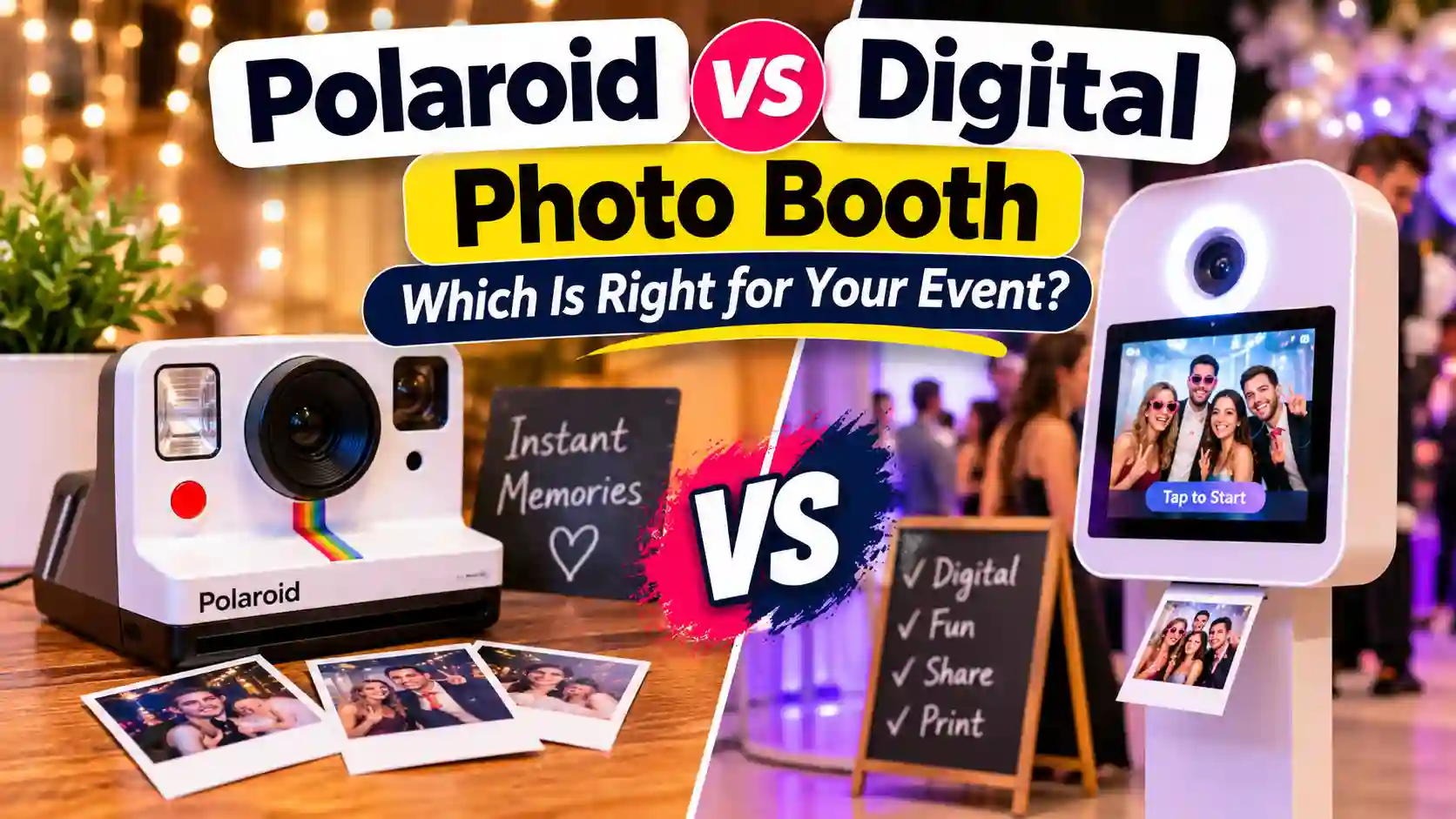
You have booked the venue, picked the playlist and ordered the cake. Still, one question keeps coming back: should guests shoot real instant film, or use a booth that prints on the spot? The short answer to polaroid vs digital photo booth is simple. Instant film suits small events with fewer than 40 guests, where the keepsake matters most. Digital wins once you pass 50 guests or want copies to share. This guide settles the polaroid vs digital photo booth choice for weddings, birthdays, corporate parties, hen nights and graduations. It compares real 2026 prices, photo quality, queues, setup and sharing, so you can pick the setup that fits your guests and budget.
Polaroid vs Digital Photo Booth: Quick Picks by Event
For most hosts, the polaroid vs digital photo booth decision comes down to guest count first and budget second. Use this table as your starting point.
| Event | Guests | Budget | Best pick |
|---|---|---|---|
| Intimate wedding | Under 40 | Medium | Instax Wide plus a Polaroid guest book |
| Large wedding | 150 | Medium to high | Digital booth with printer, plus one instant camera |
| Kids' birthday | 15 to 30 | Low | Digital with the Dog filter |
| Corporate event | 50 to 300 | High | Digital with a logo overlay and QR sharing |
| House or hen party | 10 to 30 | Low | TryPhotoBooth on a laptop plus one Instax |
| Graduation party | 50+ | Low to medium | Digital with a Class of 2027 overlay |
Between 40 and 50 guests, either option works, and the hybrid setup covered later is often the smartest move.
Why This Choice Can Make or Break Your Photo Booth
The wrong photo booth can quietly ruin the fun, even when everything else goes perfectly. Instant film runs out fast at a big wedding, and once the last pack is gone, the camera becomes table decor. A single camera also creates a line, so guests who wanted a photo give up and head back to the bar. Digital booths fail in a different way, because a stiff setup with a plain backdrop can feel cold at a cozy backyard party. Then there is the copy problem, since a real instant print has no backup. Getting the polaroid vs digital photo booth choice right helps you avoid all of these problems.
What We're Comparing: Instant Film Cameras vs Digital Photo Booths
On one side of the polaroid vs digital photo booth debate is a real instant film station. On the other side is a booth that captures a digital file first and prints second. An instant photo booth for events is usually one or two cameras on a table with spare film, pens and a guest book. The main film types are Polaroid i-Type and 600 film for cameras like the Polaroid Now+, plus the smaller Polaroid Go film. Fujifilm makes the other big option, Instax Mini and Instax Wide.
A digital photo booth uses a camera, phone or iPad with software that shows a live preview, adds a frame and saves the file. Many setups add a dye-sublimation printer, such as the DNP DS620A or a Canon SELPHY. A browser booth like TryPhotoBooth does the same job for free on a laptop or tablet.
Anatol Josepho opened his booth on Broadway in 1925, charging 25 cents for 8 photos. Edwin Land's Polaroid Model 95 then went on sale at Jordan Marsh in Boston in 1948.
Polaroid vs Digital Photo Booth: Head-to-Head Comparison
This polaroid vs digital photo booth table gives you the quick verdict. Film wins on charm and setup, while digital wins on most practical points.
| Factor | Better pick |
|---|---|
| Experience and atmosphere | Instant film |
| Photo quality | Digital |
| Cost per print | Digital |
| Customization | Digital |
| Guest experience | Digital for crowds |
| Longevity of prints | Digital, thanks to backups |
| Setup and portability | Instant film |
| Sharing | Digital |
Experience and Atmosphere
Instant film creates a moment that digital struggles to copy, because guests crowd around and watch the image slowly appear. That short wait turns into a shared story, and people often pass the print around the table before anyone pockets it. A digital booth gives a different kind of fun, since guests see themselves on screen, try poses, grab props and laugh at retakes. AR overlays like dog ears, hearts and crowns in TryPhotoBooth make the preview part of the show, which works well with kids and big groups. In the polaroid vs digital photo booth contest for atmosphere, film feels more special for each single photo, while digital keeps people playing for longer. If that slow reveal is the memory you want, instant film takes this round.
Photo Quality and Print Size
Digital usually wins on sharpness, while instant film wins on mood. A phone or tablet camera captures far more detail than a sheet of instant film. A dye-sub printer then turns that file into a clean 4x6 print or a 2x6 photo strip. Instant film has soft focus and gentle colors, which many people love because the photo looks like a memory. Film also struggles in dim reception halls, where the small flash can wash out nearby faces and leave the background dark.
Instax Mini prints are about the size of a credit card, and Polaroid prints are square with a thick white frame. Instax Wide prints are much wider than Mini, so five friends can fit in one shot without anyone getting cut off. In the instax vs polaroid debate, Wide is the safer pick for crowds. For pure sharpness, though, digital still wins any polaroid vs digital photo booth quality test.
Cost Per Print and Total Event Cost (50, 100, 150 Guests)
Digital costs far less per print, while instant film gets expensive as your guest list grows. On price, the polaroid vs digital photo booth gap is wider than on any other factor. These prices come from the brands' own US websites, as of November 2026.
| Item | Price | What you get |
|---|---|---|
| Polaroid Go color film, double pack | $21.99 | 16 photos, about $1.37 each |
| Polaroid Now+ Gen 3 camera | $149.99 | Camera only |
| Instax Mini 12 camera | $93.95 | Camera only, film in packs of 10 |
| Instax Wide 400 camera | $175.95 | Camera only, film in packs of 10 |
| Instax Mini Link 3 printer | $116.95 | Prints phone photos on Mini film |
| TryPhotoBooth | Free | Browser booth with 300 DPI export |
Here is what Polaroid Go film alone costs if each guest takes one photo. For 50 guests, 4 double packs cost $87.96. For 100 guests, 7 double packs cost $153.93, and 150 guests need 10 double packs for $219.90. The same 150 guests would need 15 packs of Instax film, plus spares for failed shots.
A digital photo booth with printer, such as the DNP DS620A, gets 400 prints from one roll, enough for a whole wedding. A rented photo booth with prints often costs a few hundred dollars for a few hours. By contrast, a free browser booth plus home photo printing costs only paper and ink. If you still want film, our guide to the best instant camera for events compares the cameras.
Customization and Branding
Digital gives you far more control over how every print looks. With instant film, customization means caption pens, stickers and washi tape, which is charming but limited. A digital booth can add your names, the date or a logo to each photo before it prints. In TryPhotoBooth, you can choose the Korean 4-cut, Classic 3-pose strip, 2x2 collage or Vintage Polaroid layout. You can then add one of 18 film-style filters, 100+ frame colors and stickers. For a corporate event, a logo on every strip turns each guest's Instagram or TikTok post into a small ad. That alone tips this polaroid vs digital photo booth round to digital. Our photo booth layouts and frames guide has more ideas.
Guest Experience and Queue Time
Digital handles crowds better, while instant film needs more care to run smoothly. Kids love pressing the shutter on an instant camera, but they can burn through a 10-shot pack in a minute. Older guests sometimes struggle with tiny viewfinders, too. Film also tends to vanish, because guests slip spare packs into their bags or take three prints each. That is why many hosts put a friend in charge of the film table.
A digital booth is much easier to leave alone, since guests see a countdown, retake bad shots for free and grab their print. The DNP DS620A prints a 4x6 in about 8.3 seconds, or up to about 430 prints an hour. So 150 guests need only about 21 minutes of total printing time. With one instant camera, each guest waits for the person ahead to frame, shoot and pass the camera back. For queues, the polaroid vs digital photo booth result is clear, because the digital line moves faster.
Longevity of Prints
A digital print backed by a saved file lasts longer in practice, because you can always print it again. Instant film prints can hold up for many years, but heat, sunlight and damp air speed up fading. Any print, including a dye-sub strip, fades faster in direct sun, so both types need the same care. Keep prints in a dark, cool and dry place, in acid-free albums or sleeves, and away from sunny windows. After a digital booth event, back up the files to cloud storage the next day, so you can reprint any photo years later. On longevity, the polaroid vs digital photo booth edge goes to digital. Our post on what to do with photo booth strips shows safe ways to display them.
Setup, Portability and Venue Needs
Instant film wins on setup, because a camera and a few packs of film take only minutes to put out. A digital booth needs more planning. You need a power outlet nearby, a steady stand for the iPad or camera, and a ring light if the room is dark. Our photo booth lighting guide covers the lighting side. Instant film has its own venue risk, though, because it does not like strong heat or cold. On a hot summer lawn or at a chilly winter party, prints can come out pale or develop badly. Keep spare packs in a cool bag away from direct sun. For a beach or barn wedding with no power, a battery-powered Instax or Polaroid camera is the easier polaroid vs digital photo booth pick.
Sharing, Privacy and Digital Copies
Digital is the only option if guests want copies on their phones. A digital booth can share each photo by QR code, text, email or an online gallery. With instant film there is just one print, so whoever takes it home owns the only copy. Privacy matters too, because some guests do not want their faces uploaded to a vendor's server. TryPhotoBooth runs in the browser and does not store photos unless someone submits one to its Weekly Spotlight gallery. In this polaroid vs digital photo booth round, digital wins, but ask for consent before posting group shots of other guests, especially children.
When to Choose a Polaroid or Instant Film Setup
Choose instant film when your guest list is small and the keepsake matters more than the number of photos. A polaroid photo booth fits best when:
- You have fewer than 40 guests
- You want a Polaroid guest book with notes beside each photo
- Your theme is vintage, boho or retro
- The venue has no power, such as a beach or a field
- The party is slow and relaxed
Think of a 30-guest garden wedding in June. One Instax Wide on a shaded table, a stack of film and a guest book give every couple a photo and a note. That album then becomes the gift you open on your first anniversary. In the polaroid vs digital photo booth choice, small and personal events like this one are where film shines.
When to Choose a Digital Photo Booth
Choose a digital photo booth once you pass 50 guests or need copies, branding or a tight budget. Digital fits best when:
- You expect 50 or more guests
- You are hosting a corporate event that needs logos and QR sharing
- Kids will be there and film would be wasted
- Your budget can't stretch to more than $1 per photo
- Guests want unlimited retakes
- You want GIFs, galleries and files to keep
For bigger crowds, the polaroid vs digital photo booth choice almost always lands on digital. A 120-person company holiday party is a good example. An iPad with TryPhotoBooth, a logo overlay, a ring light and a DNP printer lets everyone leave with a branded strip and a digital copy. Our corporate photo booth ideas post has more setups.
The Hybrid Option: Instant Camera Plus Digital Booth
The hybrid setup ends the polaroid vs digital photo booth debate by giving you film charm and digital reach at once. Put one Instax Wide 400 at the guest book table for heartfelt notes. Then set up a digital booth near the dance floor for everyone else. The cost stays low, since the camera is $175.95 and a few packs of Wide film cover the guest book. TryPhotoBooth on an iPad adds nothing to the bill. For digital prints with an instant look, the Instax Mini Link 3 printer at $116.95 turns phone photos into Instax prints. This mix suits weddings with 40 to 50 guests, where neither option alone feels quite right. It also settles the polaroid vs photo booth wedding question, because you no longer have to choose.
Polaroid Guest Book vs Digital Album for Weddings
A Polaroid guest book gives you handwritten notes beside real photos, while a digital album gives you every photo but fewer personal words. For a Polaroid camera station at a wedding, set an instant camera beside a blank album, a few pens and a short sign. A sign like "Snap a photo, stick it in and leave us a note. One photo per guest, please." works well. That last line keeps the film from running out. Plan one photo per guest or couple plus about 10% extra for failed shots, so 80 guests need about 9 packs of Instax film.
A digital album collects every booth photo in one gallery. Many couples now do both, using an instant camera for wedding guests at the book and a digital booth for the dance floor. That removes the polaroid vs digital photo booth trade-off entirely. Our wedding photo booth ideas post has more setups.
How to Make Digital Photos Look Like Real Polaroids
You can get the instant film look for free in a few clicks. The steps below use TryPhotoBooth, which works in any browser on a phone, laptop or tablet.
- Open TryPhotoBooth in Chrome or Safari and allow camera access, with no signup needed.
- Pick the Vintage Polaroid layout, which adds a white border, a caption line and a date stamp.
- Add one of the 18 film-style filters to warm the colors and soften the contrast.
- Type a caption, such as your names and the event date.
- Take the photo, retake it as often as you like, and then export it at 300 DPI.
- Print it at home on glossy photo paper, or use a Canon SELPHY for a print close to the real thing.
The print lacks the chemical texture of real film, but most guests at a party simply see a classic square photo. That makes this the cheapest answer to the polaroid vs digital photo booth argument. Read our guides to photo paper for printing at home and photo booth filters.
Which Photo Booth Fits Your Event?
Start with your guest count, because it decides most of the choice. Fewer than 40 guests with a keepsake focus points to instant film. Fifty or more guests point to digital, and anything in between suits the hybrid setup. After that, think about your budget and the feel you want, since film costs more per photo but creates a slower, warmer moment. Once you weigh those three things, the polaroid vs digital photo booth decision becomes easy. To try the digital side before your event, open our free online photo booth and make a Vintage Polaroid strip in a minute.
Frequently Asked Questions
Is a Polaroid photo booth worth it for a wedding?
A Polaroid photo booth is worth it for weddings with fewer than 40 guests. Costs stay reasonable there, and each print becomes a guest book keepsake. For bigger weddings, the polaroid vs digital photo booth math favors digital, since 150 photos on Polaroid Go film cost about $220.
How many packs of film do I need for 100 guests?
Plan one photo per guest plus about 10% for failed shots, or about 110 photos. That means 11 packs of Instax Mini or Wide film, since each pack has 10 shots. With Polaroid Go film, you need 7 double packs at 16 photos each. If guests can take more than one photo, double it.
Instax or Polaroid: which is better for a wedding guest book?
Instax is usually easier for a wedding guest book, because the photos develop faster and the cameras are simple for any guest to use. Instax Wide fits couples and groups, while Mini suits small albums. Polaroid gives a bigger square print with a classic white frame, which some couples prefer for its look.
How much does a digital photo booth cost?
A digital photo booth can cost nothing if you run a free browser booth like TryPhotoBooth on your laptop or iPad. A printer such as the Instax Mini Link 3 at $116.95 or a Canon SELPHY adds paper or film costs. Full rentals with an attendant often cost a few hundred dollars.
How do digital photo booths work?
A digital photo booth uses a camera, phone or tablet with software that shows a live preview, counts down and takes the shot. It then adds a layout or filter, saves the file and prints it or shares it by QR code. According to Wikipedia, digital booths process each photo in about 30 seconds.
Can a digital photo booth print photos on the spot?
Yes, as long as it is connected to a printer. Event booths often use dye-sub printers like the DNP DS620A, which prints a 4x6 in about 8.3 seconds. At home, you can export a 300 DPI file from TryPhotoBooth and print it on a Canon SELPHY.
Do guests care if the photos are real film?
Most guests care more about having fun and leaving with a photo than about the film itself. Real film does get a special reaction, because people love watching a print appear. Still, in most polaroid vs digital photo booth setups, a Vintage Polaroid layout gets close to that look while giving everyone a copy.
Which is more eco-friendly, instant film or digital printing?
Digital printing is usually the lower-waste choice, because you only print the photos people want. Every instant shot uses a full sheet of film with its own chemical pack, including the failed ones. So on waste, the polaroid vs digital photo booth answer favors digital, though neither option is waste-free.
Related Guides
Keep planning your event with these related guides:
Ready to try this in your browser?
Launch our free 3D studio, test out vintage filters, and save your photo strip instantly.