Polaroid Camera Review 2026: Every Popular Instant Camera Compared Honestly
Honest polaroid camera review for 2026: 14 Polaroid, Instax and Kodak cameras compared on price, real film cost per shot, flaws and who each one suits.
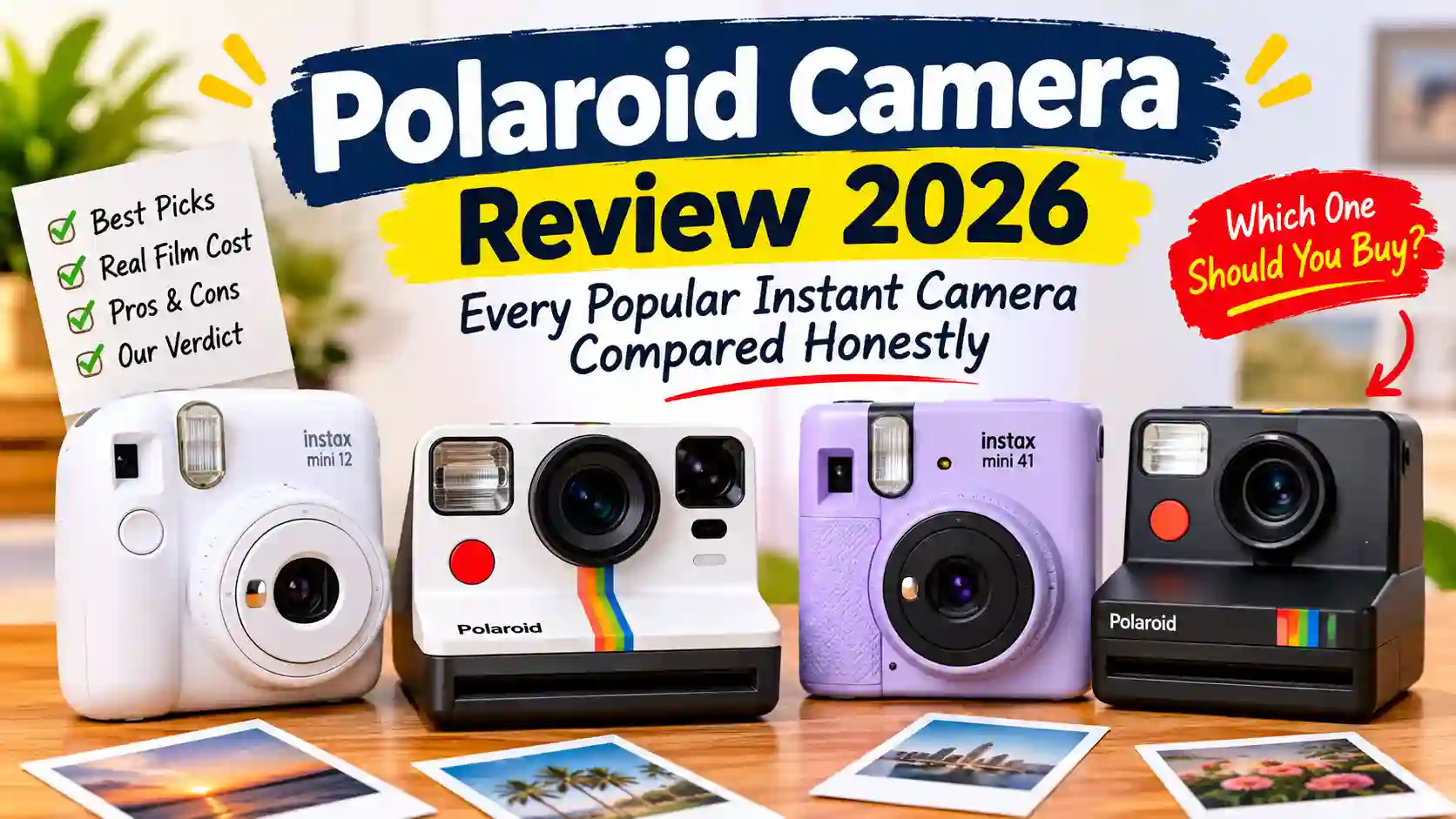
Short answer from this polaroid camera review is simple: most people should buy an Instax Mini 12 or Mini 13, and Polaroid fans should buy the Polaroid Flip. That advice comes from the one thing most guides skip, which is what every single photo costs you after the box is open. A standard i-Type Polaroid print costs between $1.80 and $2.37, while an Instax Mini print costs less than a dollar, and that gap matters more than any feature. I wrote this polaroid camera review to compare 14 popular instant cameras sold in 2026, from the tiny Polaroid Go Gen 3 to the flagship Polaroid I-2. Each camera gets its price, real film cost, honest flaws, and a score for the kind of buyer it suits best. We run TryPhotoBooth, a free online photo booth, but we sell no cameras or film and no brand paid to appear here.
Quick Verdict: The Best Instant Camera for Each Type of Buyer
If you only have a minute, this table shows the strongest pick for each kind of buyer, with a score for how well it fits that person. Split scores matter more than one overall rating, because a camera that suits a careful hobby shooter can be a poor choice for a loud birthday party. The pocket-sized Go Gen 3 shows this well, since it earns high marks for travel but scores low for group shots because its prints are small. The same logic runs through this whole polaroid camera review, so every camera section below ends with scores for different buyers instead of one number. Picks across this polaroid camera review weigh film cost as heavily as features, because the cheapest camera on the shelf can still become the most expensive one to own.
| Buyer | Best pick | Price | Why it wins | Score |
|---|---|---|---|---|
| Most people and beginners | Instax Mini 12, Mini 13 | Under $95 | Cheap film, foolproof | 9/10 |
| Classic Polaroid look | Polaroid Flip | $234.99 | Sonar autofocus, sharp prints | 9/10 |
| Travel and pockets | Polaroid Go Gen 3 | Under $90 | Smallest analog body | 8/10 |
| Full creative control | Polaroid I-2 | About $600 | On-body manual controls | 9/10 |
| Weddings and parties | Instax Mini 41 or Wide 400 | $130 to $150 | Low cost per guest | 8/10 |
| Hybrid shooters | Instax Mini Evo | About $200 | Prints only keepers | 8/10 |
| Kids on a budget | Kodak Smile+ | Check current price | Sticker prints, no chemicals | 6/10 |
Read your row first, then jump to that camera, because the sections below explain exactly where each score comes from and what could change it for you.
How I Tested These Cameras for This Polaroid Camera Review
Every camera here was judged on four things buyers actually feel day to day:
- Film cost: pack price divided by shots, so you can repeat the math.
- Print size: the real image area, not the frame size.
- Keeper rate: how often a shot comes out usable indoors, outdoors and at night.
- Carry and ease: weight, pocket size, and how fast a beginner gets a good print.
For each camera, I compared sample prints, owner photos shared on r/Polaroid and r/instax, and scans published by reviewers, so no score rests on a single lucky shot. Prices and specs for this polaroid camera review were checked in November 2026 against Polaroid, Fujifilm and Kodak listings, plus reviews from Digital Camera World, TechRadar, PetaPixel and Tom's Guide. Anything that rests on a single report, such as the rumored Instax Mini Evo 2, is marked so you know to check it first.
Stop Buying Polaroid Cameras Based on Aesthetic Instagram Photos
The photos that sell instant cameras online are usually the best few frames from many packs, shot in soft evening light and often edited before posting. Real results look different, because instant film has no screen, no undo button, and very little room for error in harsh sun or a dim room. Three surprises catch most new owners in their first month.
- Failed shots: Polaroid's own support pages say dark prints without shadow detail usually mean the scene needed more light, and regular r/Polaroid posters admit even seasoned shooters get failed frames.
- Small prints: an Instax Mini print is close to a credit card and looks tiny beside the square Polaroid frames on Pinterest.
- Film cost: one eight-shot pack of Polaroid film costs around $18.99, so a relaxed afternoon of shooting can quickly become a $40 bill.
Many people also say Polaroid when they mean any instant camera, so this polaroid camera review covers Fujifilm Instax and Kodak models as well. None of this makes instant film a bad hobby, because a print you can hold still beats a phone photo you never open again. It simply means an honest polaroid camera review has to start with realistic expectations before it praises any camera.
The Fundamental Thing You Need to Understand About Instant Film
Edwin Land built Polaroid around the idea of a photo you could hold minutes after taking it, and the 1972 SX-70 turned that idea into a folding camera. Today the deciding factor is different, because the camera is a one-time cost while instant film is a cost you pay every time you press the shutter. That is why this polaroid camera review treats film format, film cost, and development time as the first questions to answer, long before features. Get those three answers right, and choosing between a dozen similar cameras becomes far easier than any spec sheet suggests.
Pick Your Format First, Then Your Camera
Each instant system uses its own film, so buying a camera also means choosing the film you will keep buying for years. This is what each format puts in your hand.
- Polaroid i-Type film and 600 film: the classic 79 x 79 mm square image.
- Polaroid Go film: a smaller square of about 47 x 46 mm.
- Instax Mini film: a 62 x 46 mm rectangle, about credit-card size.
- Instax Square film: a square that sits between Mini and Polaroid.
- Instax Wide film: the largest Instax print, made for groups.
- Kodak Zink and dye-sublimation prints: no wait, but flatter colors.
On Instax vs Polaroid image quality, Instax prints look cleaner and sharper, while Polaroid prints look softer and dreamier. Choose the polaroid print size or Instax format first, and the polaroid vs instax choice makes itself. Every verdict later in this polaroid camera review assumes you have made that choice.
Real Cost Per Shot in 2026 (With the Math)
No polaroid camera review is complete without this table, because polaroid film cost per shot is the number that shocks most new owners after their first month.
| Film | Shots per pack | Typical price | Cost per shot |
|---|---|---|---|
| Polaroid i-Type, single pack | 8 | $18.99 | $2.37 |
| Polaroid i-Type, five-pack deal | 40 | $71.99 | $1.80 |
| Polaroid Go film | 16 | $21.99 | $1.37 |
| Instax Mini, twin pack | 20 | $18.17 | $0.91 |
| Instax Square or Wide | 10 to 20 | Varies | $0.85 to $1.20 |
| Kodak Zink paper | 10 | $10 | $1.00 |
The numbers behind the table point to a few practical lessons.
- UK prices match: on 23 September 2026, the official stores charged £2.12 for an i-Type photo and 85p for an Instax Mini photo.
- Weddings show the gap: about 200 guest photos cost roughly $130 to $160 on Instax Mini film and about $400 on Polaroid film.
- Bulk packs help: buying Polaroid film in five-packs cuts the price of every shot by roughly a quarter.
- Go film is cheaper than people think: some guides call it the priciest Polaroid option, but at $1.37 a photo it is now the cheapest way to shoot Polaroid.
If you keep asking if Polaroid film worth it, multiply your monthly shots by twelve and then by the cost per shot before deciding.
Development Time: 90 Seconds vs 15 Minutes
Instax prints develop in about 90 seconds, while Polaroid i-Type film takes 10 to 15 minutes to reach its final colors, so Polaroid is less instant than its name suggests. That wait changes party shooting, because guests want to see the photo right away, which is one reason this polaroid camera review favors Instax for events. Power works differently too, since i-Type cameras carry a rechargeable battery while 600 film packs hold a battery for older vintage cameras.
Camera-by-Camera Honest Assessment (2026 Models)
Every camera below is a current 2026 model, which matters because many guides still review the older Polaroid Now, Polaroid Go Gen 2 and Instax Wide 300. Each section covers price, film cost, what changed, strengths, flaws, and split scores, so this polaroid camera review stays easy to compare across brands, prices, and print sizes.
Polaroid Go Gen 3 ($89.99)
The Polaroid Go Gen 3 launched in June 2026 at $89.99, or $109.99 with film, and Polaroid calls it the smallest instant analog camera in the world. Any useful Polaroid Go review starts with the lens, because Gen 3 swaps the old 34mm equivalent lens for a 42mm equivalent at f/14.4 and f/32.
- What changed: the lens sits deeper in the body to cut glare, and a stronger flash fixes the soft, muddy indoor shots that Gen 2 owners complained about.
- Strengths: it weighs 251.9 grams, fits a jacket pocket, and keeps the selfie mirror, self-timer, and double exposure, with a flash you can now switch off.
- Film cost: Go film costs $21.99 for 16 shots, so every press of the shutter is cheaper than on i-Type film, which suits casual shooters who take lots of everyday snaps.
- Honest flaws: the image area is only about 47 x 46 mm, roughly 1.85 inches square, and the built-in battery lasts about 120 shots per charge but cannot be replaced.
This polaroid camera review scores the Go Gen 3 at 8/10 for travel, 7/10 for gifts and 4/10 for group photos.
Polaroid Now Gen 3 ($119.99)
Polaroid's Now Gen 3 costs about $119.99 and is the camera most people picture when they hear the word Polaroid. An honest Polaroid Now Gen 3 review should start with the light meter, which Polaroid moved to the same spot as on the Now+ for better exposure and Now+ filter support.
- Key specs: it takes both i-Type film and 600 film, weighs about 448 grams and uses a body made from roughly 40% recycled materials.
- Strengths: two-zone autofocus switches between near and far focus, and you also get a self-timer, double exposure, a tripod mount and USB-C charging.
- Style: Pink and Teal versions joined the range in 2026, so it remains one of the best-looking gifts in the instant camera aisle.
- Honest flaws: some buyers report overexposed or failed prints and say the plastic feels cheaper than before.
- Film cost: i-Type prints cost $1.80 to $2.37 each, and a casual weekend can easily use two packs.
My polaroid camera review gives the Now Gen 3 7/10 for careful hobby shooters and 7/10 for gifts, while busy parties get 5/10 because every miss costs money.
Polaroid Now+ Gen 3 ($139.99 to $164.99)
The Polaroid Now+ Gen 3 costs $20 to $45 more than the standard Now, and that extra money buys the creative tools the Now leaves out.
- Creative tools: its Bluetooth link to the Polaroid app unlocks manual mode, aperture priority, and double exposure, so you can learn real exposure skills.
- What changed: Polaroid tuned Gen 3 for better exposure in bright light, which was a common complaint about older Now+ models.
- Honest flaws: most of the extra control lives inside your phone, so changing settings is slower than turning a real dial on the camera.
- Film cost: film costs the same as the Now, so long exposures and light painting can burn through expensive packs quickly.
Judged by this polaroid camera review, the Now+ Gen 3 earns 8/10 for creative learners, 6/10 for casual users, and only 5/10 for parties.
Polaroid Flip ($234.99)
The Polaroid Flip costs about $234.99 and is the Polaroid I would recommend to most people who want classic square prints. Digital Camera World called it the best Polaroid you can buy without spending $600 on the I-2, and most Polaroid Flip review coverage praises its consistent focus.
- Sonar autofocus: it sends out sound waves to measure distance, the same idea Polaroid used decades ago on the SX-70 Sonar and SLR 680.
- Hyperfocal four-lens system: the distance reading picks one of four lenses with sweet spots at 0.65, 0.85, 1.2 and 2.5 meters.
- Low-light strength: sonar does not rely on light, so focus works in total darkness, and the flip-up flash is the most powerful Polaroid has fitted.
- Film and app: it accepts i-Type and 600 packs, with full manual control available through the Polaroid app on your phone.
- Honest flaws: it is bulky, and a Gizmodo reviewer loved its vintage feel but not its vintage weight.
If you only buy one Polaroid after reading this Polaroid camera review, the Flip is the safest choice for sharp prints. Its scores are 9/10 for the classic look and 8/10 for parties, with travel at 5/10 because of its size.
Polaroid I-2 ($599.99)
The Polaroid I-2 costs $599.99 to $614.99 and is the first analog instant camera with manual controls built into the body.
- Lens: a sharp 98mm f/8 lens, roughly a 38mm f/3.2 equivalent, with seven aperture stops from f/8 to f/64.
- LiDAR autofocus: a laser distance sensor like the ones on recent phones, working from 0.4 meters to infinity even in dim light.
- Shooting modes: auto, shutter priority, aperture priority, manual and multi-exposure, plus a 49mm filter thread for screw-on filters.
- Honest flaws: there is no manual focus at all, and TechRadar warned that the price plus i-Type film costs will put off all but loyal fans.
A fair Polaroid I-2 review has to say who it is really for, which is people who already shoot film and want the sharpest square prints Polaroid has ever made. Anyone new to exposure settings will learn faster and waste less film on the Flip covered above. On my Polaroid camera review scale, the I-2 scores 9/10 for skilled hobbyists, 4/10 for beginners, and 3/10 for parties.
Fujifilm Instax Mini 12 vs Mini 13 ($80 to $94)
The Instax Mini 12 sells for around $80 to $89, while the Instax Mini 13 launched in 2026 at $93.95 in the US and £79 in the UK. Any Instax Mini 13 review comes down to selfies, and any Instax Mini 12 review still applies to both, because so little has changed.
- What the Mini 13 adds: a 2-second and 10-second self-timer, plus a strap wedge that tilts the camera upward on a table.
- What stays the same: the 60mm lens at f/12.7, automatic exposure, shutter speeds from 1/2 to 1/250 second, and Instax Mini film.
- Strengths: both cameras are nearly foolproof, and film costs about 80 cents a shot.
- Honest flaws: the flash fires every time and cannot be turned off, bright sun can overexpose shots, and there is no double exposure or manual control.
- Smart buy: PetaPixel points out that a discounted Mini 12 gives you the same photos without the timer.
Prints are small at 62 x 46 mm, which disappoints buyers who expected Polaroid-sized squares from a camera in this price range. Even so, the pair is the best instant camera for beginners right now, because cheap film lets new shooters learn without fear. Both models score 9/10 for beginners, 9/10 for gifts, and 6/10 for creative shooters on our polaroid camera review scorecard.
Fujifilm Instax Mini 41 ($129.95)
The Instax Mini 41 costs about $129.95 and wraps the simple Mini formula in a retro body that looks closer to a classic film camera.
- Close-up mode: it corrects parallax, so the framing in the viewfinder matches the print when you shoot from arm's length.
- Wedding favorite: that accuracy makes it a popular guest-book camera, where many strangers will use it only once.
- Film cost: it uses standard Instax Mini film, which matters when dozens of guests each want a turn.
In my scoring for this polaroid camera review, the Mini 41 earns 8/10 for weddings, 8/10 for style-focused buyers, and 6/10 for creative control.
Fujifilm Instax Mini 99 ($199)
The Instax Mini 99 costs about $199 and is the most capable analog Instax camera you can buy right now.
- Creative control: it adds tools that the Mini 12 and Mini 41 lack, so you can shape the look of a print without moving to a digital hybrid.
- Low light: it handles dim scenes better than cheaper Instax models, which helps in restaurants and living rooms.
- Honest flaws: its price lands close to the Polaroid Flip, so you need to love the Mini format to justify it.
Scored against the other cameras in my Polaroid camera review, the Mini 99 earns 8/10 for creative Instax fans, 6/10 for beginners, and 7/10 for low light.
Fujifilm Instax Mini Evo ($199 to $219)
The Instax Mini Evo costs about $199 to $219 and is a hybrid instant camera, which means it shoots digitally and prints onto Instax Mini film only when you choose. A complete Instax Mini Evo review has to cover both halves of that idea.
- Film savings: you check every frame on the screen and skip printing the blinks, blurs and bad angles.
- Digital extras: the Instax app sends photos to your phone and lets you print phone pictures on the same film.
- Reviewer support: Tom's Guide ranks the original Evo as its best instant camera overall.
- Honest flaws: the print comes from a digital file, and some fans feel that removes the surprise that makes instant film special.
- Coming soon: one report says an Instax Mini Evo 2 arrives in late November 2026 at $289, but verify it because it comes from a single source.
Under our polaroid camera review scoring, the Mini Evo scores 8/10 for hybrid shooters, 8/10 for travel, and 5/10 for analog purists.
Fujifilm Instax Wide 400, the Wide 300 Replacement ($149)
The Instax Wide 400 costs about $149 and replaces the Instax Wide 300, which many older guides still recommend to buyers.
- Big prints: Instax Wide film gives the largest Instax print, so two to four people fit in one frame without squeezing.
- Film cost: film runs roughly a dollar a shot, which keeps party group photos far cheaper than the same shots on Polaroid.
- Honest flaws: controls stay basic, so treat it as a reliable event point-and-shoot rather than a creative tool for experiments.
- Alternative: the Lomo'Instant Wide from Lomography uses the same film and gives you more manual control.
The old Wide 300 earned a reputation as a camera whose format was better than the body, and the Wide 400 mainly modernizes that same idea with a fresher design. This polaroid camera review gives the Wide 400 a 9/10 for groups and 8/10 for weddings, though travel drops to 5/10.
Fujifilm Instax Wide Evo ($349.99)
The Instax Wide Evo costs $349.99 and brings the hybrid Evo idea to Instax Wide film, with a digital preview before every print.
- Price position: Tom's Guide placed it in the same price group as the Leica Sofort 2, far above normal Instax pricing.
- Value problem: Digital Camera World struggled to find enough extra value over printing phone photos to a cheaper Instax Wide printer.
- Who it suits: wide-format fans who want one device for shooting, previewing and printing.
It is a lovely camera to hold, but most people can get similar prints for much less money another way. This Polaroid camera review gives it 7/10 for wide-format fans with a big budget and 4/10 for value.
Fujifilm Instax Square SQ40 and Square 2
Instax Square film is the closest Fujifilm gets to the Polaroid look, and Engadget picks the Instax Square SQ40 as its best instant camera overall.
- Instax Square 2: announced on 14 October 2026 at €109.99 in Europe, with twist controls, three shooting modes and a Warm or Cool mood filter.
- New film: Soft Haze Square film launched alongside it, giving softer colors with glowing highlights and warm shadows.
- US price: US pricing for the Square 2 was not confirmed when this guide was written, so check before you order.
Square film costs more per shot than Mini, but it still undercuts Polaroid, so this polaroid camera review gives both cameras 8/10 for square prints on a budget.
Instax Mini LiPlay+ and Mini Evo Cinema, the Hybrid Picks
These two cameras are the most playful hybrids in the Instax range, and both trade value for novelty.
- Instax Mini LiPlay+: a compact hybrid that prints Instax Mini photos and can attach a short sound recording through the app.
- LiPlay+ price: Tom's Guide notes that it costs more than both the Mini Evo and Mini 99, so you pay extra for the audio trick.
- Instax Mini Evo Cinema: launched in January 2026 at $409, it records 15-second video clips as well as stills and prints.
- Cinema reviews: WIRED gave it 5/10 and called it the most expensive Instax camera yet.
Both cameras work best as fun gadgets rather than everyday cameras. Within this polaroid camera review, they score 7/10 for gadget lovers and 4/10 for value.
Kodak Smile+ and Mini Shot 3 Retro, the Budget Alternatives
Kodak's cameras are the only ones in this polaroid camera review that skip chemical film entirely, which makes them the least fussy choice for young children.
- Kodak Smile+: prints on sticky-backed Zink paper that costs about $10 for 10 sheets in the US, or around a dollar a print.
- Smile+ flaws: Tech Advisor found its prints very hit and miss, with flatter color than Instax film.
- Kodak Mini Shot 3 Retro: uses dye-sublimation printing at 291 x 300 dpi for 3 x 3 inch prints that resist water and fading.
- Mini Shot 3 flaws: it does not keep a library of photos, so anything you delete before printing is gone for good.
Our polaroid camera review scores are 6/10 for the Smile+ with kids and 7/10 for the Mini Shot 3 Retro as a casual printer.
Side-by-Side Comparison Table: All 14 Cameras
This instant camera comparison puts the main model from each section of this polaroid camera review in one table, with price, film, cost per shot, and best use. Prices are typical US retail figures from November 2026, and film costs assume standard packs rather than bulk deals. Euro and single-source prices are worth checking again before you buy, since launch prices often shift within a few months.
| Camera | Price | Film | Cost per shot | Best for |
|---|---|---|---|---|
| Polaroid Go Gen 3 | $89.99 | Polaroid Go | $1.37 | Travel |
| Polaroid Now Gen 3 | $119.99 | i-Type and 600 | $1.80 to $2.37 | Classic gifts |
| Polaroid Now+ Gen 3 | From $139.99 | i-Type | Same as Now | Creative learners |
| Polaroid Flip | $234.99 | 600 and i-Type | Same as Now | Best Polaroid overall |
| Polaroid I-2 | $599.99 | i-Type or 600 | Same as Flip | Skilled shooters |
| Instax Mini 12 | $80 to $89 | Instax Mini | $0.80 | Beginners |
| Instax Mini 13 | $93.95 | Mini | 80 cents | Selfies |
| Instax Mini 41 | $129.95 | Instax Mini film | About $0.80 | Weddings |
| Instax Mini 99 | $199 | Mini film | $0.80 | Creative Instax |
| Instax Mini Evo | $199 to $219 | Instax Mini | Per print chosen | Hybrid shooting |
| Instax Wide 400 | $149 | Instax Wide | $0.85 to $1.20 | Groups |
| Instax Wide Evo | $349.99 | Instax Wide | Same as Wide 400 | Wide hybrid |
| Instax Square 2 | €109.99 | Instax Square | About $1.00 | Square on a budget |
| Kodak Smile+ | Check current price | Zink | $1.00 | Kids |
Use the cost column to estimate a full year of shooting before you act on any verdict from this polaroid camera review, because that number changes most shortlists.
The Temperature Problem Nobody Warns You About
Polaroid film reacts strongly to temperature, and no polaroid camera review should skip it, because it ruins more winter photos than any camera fault. The chemistry works best inside a comfortable range, and prints suffer on either side of it.
- Below about 55°F (13°C): development slows down, so prints often come out pale and washed out.
- Above about 90°F (32°C): development runs unevenly, which leaves patchy color and weak contrast.
A few simple habits fix most of these temperature problems.
- Cold days: slide each print into an inside pocket so your body heat keeps it warm while it develops.
- Hot days: keep the camera and spare packs out of direct sun, and never leave either one inside a parked car.
- Fresh prints: shield each print face down or in a pocket as it ejects, because new prints are sensitive to light.
- Film storage: keep unused packs in the fridge, then let them return to room temperature before loading.
Instax film handles cold far better, which is why this polaroid camera review calls Instax the safer choice for ski trips and winter weddings. Shooting Polaroid in cold weather is still possible with a little planning, yet any Instax camera will give you fewer ruined prints in winter.
Why Your Polaroid Photos Come Out Dark and How to Fix It
Why are my Polaroid photos dark is one of the most common questions on r/Polaroid, and the usual answer is simply too little light. Polaroid's support team says dark prints without shadow detail almost always need more light, because i-Type film is only ISO 640 and the lenses are slow. Work through these common causes in order before blaming the camera:
- Dim rooms: keep the flash on and stay within a few meters of your subject, since the flash cannot light a whole room.
- Bright backgrounds: a bright sky behind a person tricks the light meter into darkening the face, so turn your subject toward the light.
- Old film: expired or badly stored packs can come out dark or faded, so check the date on each box and keep packs cool.
- Blocked sensor: a finger or strap covering the light meter can darken good-light shots, so check your grip.
Overexposed prints are a separate problem, and unlike digital files they cannot be repaired after they develop. If dark prints keep frustrating you, this polaroid camera review points you toward the Flip or I-2.
When a Hybrid Camera or Digital Print Is Actually the Better Choice
Real instant film is not the right tool for every job, and admitting that can save you a lot of money. A digital route makes more sense in the following situations.
- You hate wasted prints: a hybrid instant camera such as the Instax Mini Evo, Mini LiPlay+, or Wide Evo lets you preview first and print only the keepers.
- You want copies to share: hybrids keep a digital file of every photo, which matters for weddings and trips.
- Your photos are already on your phone: an Instax Wide printer or the Kodak Mini Shot 3 Retro prints them without a new camera.
- You expect hundreds of guests: digital photostrips printed at home usually cost far less per print than any film.
For that last case, our free browser booth at TryPhotoBooth builds 4-cut strips and a Polaroid-style layout with a caption and date. Every strip downloads at 300 DPI without a watermark, and no signup is needed. The trade-off is feeling, because a print made from a digital file never carries the surprise of watching real chemistry reveal an image. The advice from this polaroid camera review is simple: choose digital for volume and safety, and choose real film when the surprise is the whole point.
What to Buy Based on What You Actually Want
Use these quick picks if you already know how and where you will shoot. Each one matches a real buying situation covered by this polaroid camera review instead of a simple spec sheet ranking or a list of features.
For Beginners and Gifts
First-time buyers should start with the Instax Mini 12 and its twin, the Mini 13, the top beginner picks throughout this polaroid camera review, because cheap film and auto exposure make good results easy. For a gift, buy whichever of the two is cheaper on the day, since both share the same lens, film, and photo quality.
For Weddings and Parties
For a wedding guest-book table, the Instax Mini 41 is the safest pick, while the Instax Wide 400 suits couples who want group shots of friends. Plan for about 200 exposures for 100 guests, as The Knot suggests, and stick with Instax film. The math earlier in this polaroid camera review shows Polaroid film costing more than twice as much for that volume.
For Travel and Pockets
Polaroid's Go Gen 3 is the easiest camera to carry in the whole polaroid camera review, since it weighs 251.9 grams. Its prints are small, though, so pack an Instax Mini camera instead if you want larger photos and cheaper film on a long trip.
For the Classic Polaroid Look
If you want the square white-framed Polaroid look, buy the Polaroid Flip for its sonar autofocus and consistently sharp results. If $234.99 feels like too much, the Now Gen 3 reviewed earlier gives the same i-Type prints for about $119.99 with simpler two-zone focus.
For Creative Control
Experienced shooters should buy the Polaroid I-2, the most advanced camera across this Polaroid camera review, for its manual controls and LiDAR autofocus. If $599.99 is out of reach, the Polaroid Now+ Gen 3 offers manual modes through the app, while the Instax Mini 99 gives creative control with cheaper film.
For Kids on a Tight Budget
Young children do well with the Kodak Smile+, because its sticker prints need no developing and Zink paper costs about a dollar a sheet. Older kids who want real film are better served by the Instax Mini 12, the budget pick of this polaroid camera review.
Frequently Asked Questions
These are real questions from Reddit and forum threads, answered with the same facts used throughout this polaroid camera review.
Should I buy a Polaroid or an Instax as a beginner?
Most beginners do better with an entry Instax such as the Mini 12 or 13, because film costs under a dollar and automatic exposure forgives mistakes. Choose Polaroid only if you love the larger square print enough to pay about two dollars a photo, and read our Polaroid photography guide for beginners before your first pack.
Why are my Polaroid pictures coming out so dark?
Most r/Polaroid threads on this question trace the problem back to low light or shooting without the flash. Retake the same scene in daylight with the flash on, and if prints stay dark, suspect old film or a faulty light meter.
Can you fix an overexposed Polaroid after it develops?
No, an overexposed Polaroid cannot be fixed once the chemistry finishes, because the lost detail was never recorded on the film. Scanning and darkening it helps the digital copy, but the physical print itself will always stay pale.
Is Polaroid film worth the price in 2026?
Polaroid film is worth it if you love the large square frame and soft, dreamy colors, but each shot costs close to two dollars. People who shoot every week usually switch to Instax, which gives cleaner and sharper prints for well under half the price.
Can I use Instax film in a Polaroid camera?
No, Instax film and Polaroid film use different sizes and chemistry, so neither one fits the other brand's cameras. Even inside Polaroid, Go film only works in Polaroid Go cameras, and i-Type film lacks the battery that vintage 600 cameras need to run.
How much does each Polaroid photo actually cost?
A single eight-shot pack of i-Type film costs about $18.99, or $2.37 a photo, and a five-pack deal drops that to about $1.80. Go film is cheaper again at about $1.37, although its prints are much smaller than i-Type.
Is the Polaroid I-2 really worth $600?
The I-2 is worth $600 only if you understand aperture and shutter speed and want the sharpest Polaroid prints. One Reddit user coming from a Sony mirrorless camera called its exposure learning curve expensive, so beginners will get more from the Flip, the top Polaroid pick in my Polaroid camera review.
Is the Instax Mini 13 worth upgrading to from the Mini 12?
Upgrading makes little sense for most owners, because the Mini 13 keeps the same lens, film and exposure system as the Mini 12. Its only real additions are a self-timer and a strap stand, which mainly help people who take group selfies.
Which instant camera is best for a wedding?
The Instax Mini 41 is our polaroid camera review's wedding pick, thanks to its close-up mode and cheap Mini film. Add an Instax Wide 400 for group shots if your budget allows, since wide prints fit several smiling guests into one frame.
Do Polaroid photos fade over time?
Modern Polaroid prints are far more stable than early Impossible Project film, but they still fade when left in direct sunlight for long periods. Keep them in albums or boxes away from light and heat, avoid PVC sleeves, and scan your favorites as a backup.
Keep Reading
These guides answer the next questions readers of this polaroid camera review ask:
- 14 ideas for displaying and protecting photo strips
- Why home photo printing beats a lab
- How an online photo booth works
The Bottom Line
Pick your film format first and your camera second, because film cost decides how much you will actually shoot. For most people, the Instax Mini 12 or its successor gives the best mix of price, ease, and cheap prints. The Polaroid Flip is the best way to get classic square Polaroid photos without paying $599.99 for the I-2. Travelers should look at the Polaroid Go Gen 3, groups suit the Instax Wide 400, and hybrid fans will be happiest with the Instax Mini Evo. If this Polaroid camera review leaves you with one habit, let it be multiplying cost per shot by how often you shoot before buying.
Ready to try this in your browser?
Launch our free 3D studio, test out vintage filters, and save your photo strip instantly.