Polaroid Photography for Beginners: An Honest Guide to Cameras, Film and Better Shots
Learn Polaroid photography for beginners with simple camera tips, film costs, lighting advice, and easy ways to take better instant photos.
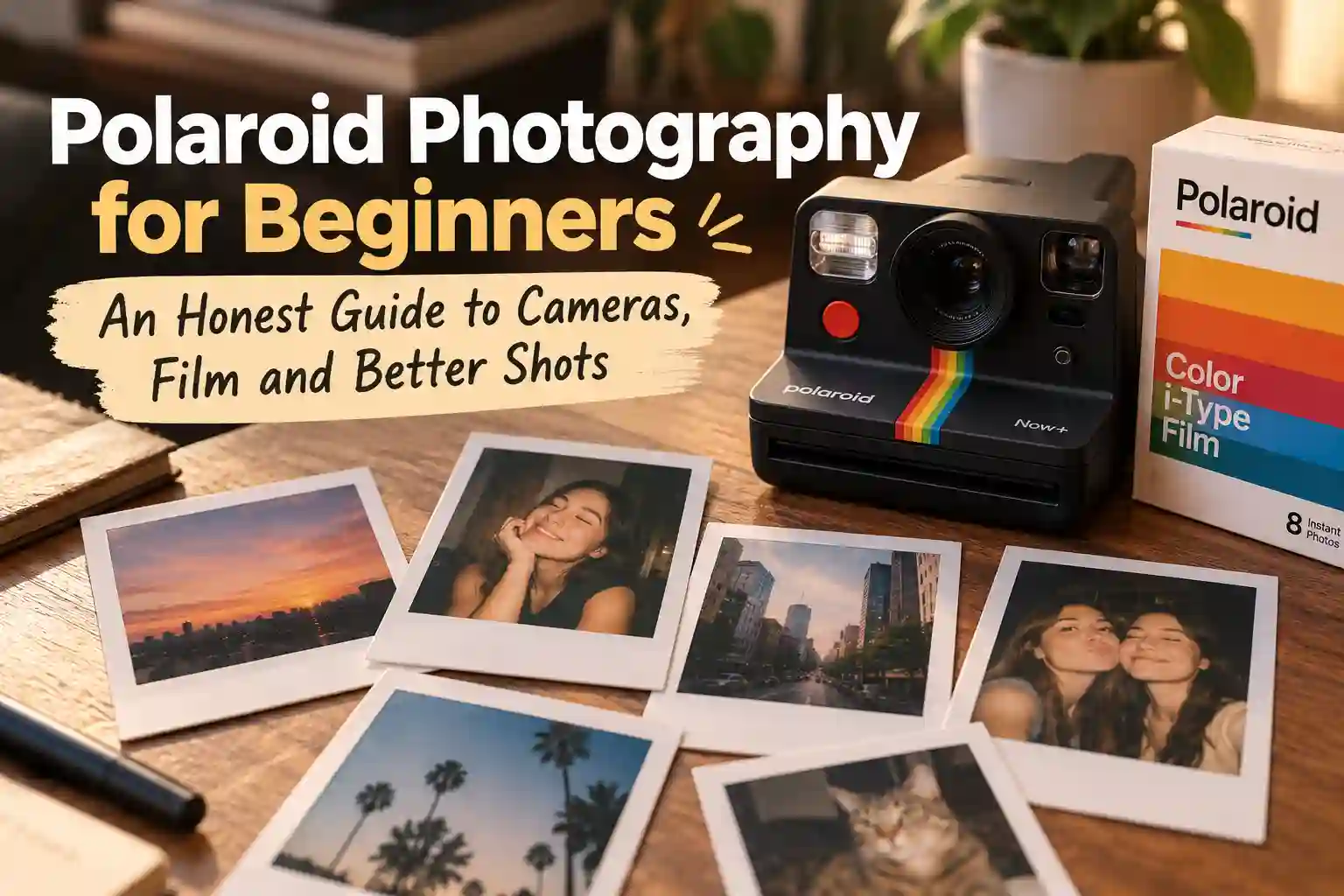
You have probably seen soft, dreamy Polaroids on Instagram and Pinterest, and now you want a camera that gives you a real photo to hold. Polaroid photography for beginners is a lot of fun, but it costs more than most people expect. That is because every single shot uses film that you pay for. This guide gives you the honest version, with real prices as of October 2026 and simple tips that save film. By the end, you will know if Polaroid photography fits your life, or if a cheaper Instax camera suits you better.
Before trying a real Polaroid camera, it helps to understand how much lighting, framing, and photo style can change the final result. You can practise these basics with TryPhotoBooth, a free online photo booth that lets you create vintage Polaroid-style pictures directly in your browser. Try different poses, experiment with the Vintage filter, and explore the frame options before spending money on instant film. This is a simple way to discover the retro photo style you enjoy and learn how to frame your shots.
Before You Buy: What Nobody Tells You About Polaroid Photography for Beginners
The truth is that the camera is the cheap part, and the film is where your money really goes. A pack of Polaroid i-Type film costs $18.99 for just 8 photos, so each picture costs you about $2.37. Some shots will also fail while you learn, and that hurts more when every frame has a price.
Light and temperature matter far more in Polaroid photography than on a phone camera. The film needs a lot of light, so dark rooms without flash give you muddy prints. Cold and heat change the colours too, which is why a winter photo can look blue.
None of this means you should skip it, because holding a real print is still special. It simply means you should start with a small budget for mistakes and a plan for your first pack.
What Polaroid Photography Is (and What It Isn't)
Polaroid photography means shooting on instant film that turns into a finished print a few minutes after you press the button. Polaroid is the name of one brand, while Fujifilm Instax is its biggest rival, and both make instant cameras. People often say "Polaroid" for any instant photo, but the films do not mix between the two brands.
The magic happens inside the print itself. When the photo comes out, rollers break a small pod of chemical paste and spread it across the film. A dark layer then protects the picture from light while it develops, and it slowly clears to show your image (Wikipedia: Instant film).
The story started when Edwin Land founded Polaroid in Cambridge, Massachusetts, in 1937. His SX-70 camera brought this self-developing film to the world in 1972. When Polaroid stopped making film in 2008, the Impossible Project saved the last factory, and the brand came back as simply Polaroid in 2020.
Polaroid vs Instax: Pick Your Film Before Your Camera
You should choose your film first, because each camera takes only one type of film, and that film sets your running costs. Polaroid film gives bigger, softer and more vintage prints, while Instax film is cheaper and more forgiving in tricky light. Here is how the main films compare as of October 2026.
| Film | Image size | Shots | Price | Fits |
|---|---|---|---|---|
| Polaroid i-Type | 3.1 × 3.0 in | 8 | $18.99 | Now, Now+, Flip, I-2, Mod |
| Polaroid 600 | 3.1 × 3.0 in | 8 | Check price | Vintage 600 and i-Type cameras |
| Polaroid Go | 2.6 × 2.1 in (whole print) | 16 (double pack) | $21.99 | Polaroid Go only |
| Instax Mini | 46 × 62 mm | 10 | Check price | Instax Mini cameras |
| Instax Square | 62 × 62 mm | 10 | Check price | Instax Square cameras |
| Instax Wide | 99 × 62 mm | 10 | Check price | Instax Wide cameras |
Polaroid lists its film prices on polaroid.com. If you want the thick white border that defines Polaroid photography, pick Polaroid, but Instax Mini gives you more photos for the same money.
Choosing Your First Camera: Best Polaroid Camera for Beginners
The best Polaroid camera for beginners depends on your budget and how you like to shoot. The Polaroid Now Gen 3 is the safest first pick for most people. The Polaroid Go suits travel and small budgets, and an Instax Mini 12 is the cheapest way to start shooting instant film. Your pick shapes your Polaroid photography budget for years.
Polaroid Go Gen 3 ($89.99): Small, Cheap, Fun
The Polaroid Go Gen 3 costs $89.99 and is the smallest Polaroid you can buy, so it fits in a jacket pocket or a small bag. It only takes Polaroid Go film, which gives tiny prints that are much smaller than a normal Polaroid.
That small size suits travel, concerts and festivals, where a big camera would get in the way. It also has a selfie mirror on the front, so you can take quick photos of you and your friends.
Polaroid Now Gen 3 ($129.99): The Safe First Choice
The Polaroid Now Gen 3 costs $129.99 and is the camera most beginners should start with. It takes both i-Type and 600 film, and its autofocus picks between close and far shots for you. That means you get sharper photos without worrying about distance.
It also has a self-timer for group photos and a double exposure mode for creative shots. Because it is simple, sturdy and easy to find, it is the easiest camera to recommend to anyone starting Polaroid photography.
Polaroid Now+: More Creative Control
The Polaroid Now+ looks like the Now, but it connects to the Polaroid app on your phone and comes with colour lens filters. Through the app, you can try long exposures and light painting, which gives you more creative room once the basics feel easy.
Check the current price on polaroid.com before you buy, because it changes with sales and bundles. If you only want simple snapshots, the regular Now will serve you just as well and costs less.
Polaroid Flip, I-2 and Mod: When to Step Up
The Flip, I-2 and Mod are for people who already love instant film and want more control over each shot. The I-2 offers full manual settings, while the Flip has a more advanced focus system. The Mod costs $169.99, takes i-Type and 600 film, and has two focus zones that cover 0.4 m to infinity.
Its creative dial offers double exposure, split shot, motion freeze and light painting, and it charges through USB-C.
Fujifilm Instax Mini 12: The Cheapest Way to Start
The Fujifilm Instax Mini 12 is the cheapest way to start, because Instax Mini film costs far less per shot than Polaroid film. The camera sets the brightness for you, so beginners get fewer dark or white mistakes. Its prints are about the size of a credit card, which makes them easy to slip into a wallet or phone case.
Fujifilm also sells the newer Instax Mini 13, so compare both on the Fujifilm instax page. The main downside is that the prints are small and look less like classic Polaroid photography.
Fujifilm Instax Wide 400 (and the Older Wide 300)
The Fujifilm Instax Wide 400 makes prints that are twice as wide as Instax Mini, so you can fit a whole group of friends into one photo. That makes it great for weddings, birthdays and family trips. The older Wide 300 still sells second hand and uses the same Instax Wide film, which can save you money.
Its body is big and bulky, though, so it is not fun to carry all day.
Quick Picks: Which Camera Fits You?
The easiest way to choose is to match the camera to how you will use it. The Go suits travel, and the Now Gen 3 is the best first Polaroid. The Mod fits creative shooters, while the Instax Mini 12 suits small budgets.
| Camera | Price | Cost per shot |
|---|---|---|
| Polaroid Go Gen 3 | $89.99 | about $1.37 |
| Polaroid Now Gen 3 | $129.99 | $2.13 to $2.37 |
| Polaroid Mod | $169.99 | $2.13 to $2.37 |
| Instax Mini 12 | Check price | Lowest |
Understanding Film Costs: What Polaroid Photography Really Costs in a Year
Polaroid photography costs about $2.13 to $2.37 for every photo on i-Type film, so your film will soon cost more than your camera. If you shoot one pack a month, you get 96 photos a year. The total for your first year then adds up faster than most beginners expect.
| Film | Pack price | Shots | Cost per shot |
|---|---|---|---|
| i-Type single pack | $18.99 | 8 | about $2.37 |
| i-Type in a five-pack | $17.00 each | 8 | about $2.13 |
| Go film double pack | $21.99 | 16 | about $1.37 |
Here is what your first year really costs if you shoot one pack a month.
| Setup | Camera | Film for 96 photos | First-year total |
|---|---|---|---|
| Polaroid Now Gen 3 with i-Type | $129.99 | $204.00 | about $334 |
| Polaroid Go Gen 3 with Go film | $89.99 | $131.94 | about $222 |
Buying i-Type in a triple pack brings the price down to $17.66 a pack, and a five-pack brings it down to $17.00. Instax film costs roughly $0.70 to $1.40 a shot, so it is the better choice if you plan to shoot a lot.
Your First Pack: 5 Steps to Your First Good Polaroid
Your first pack goes best when you follow five simple steps. Load the film, let the dark slide come out, find good light, stand at the right distance, and protect the photo while it develops. These steps fix most beginner mistakes in Polaroid photography, so they are the heart of how to use a Polaroid camera well.
- Load the film. Open the film door, slide the pack in with the dark slide facing up, and close the door gently.
- Let the dark slide eject. The camera pushes out a black cover sheet on its own. Let it come out, and never pull it by hand.
- Find good light. Stand in open shade or face away from the sun, and keep the flash on whenever you are indoors.
- Stand at the right distance. Stay about 1 to 1.2 m (3 to 4 ft) from your friend for a portrait. This keeps the face sharp.
- Shield the photo and wait. Let the print rest under the film shield for a few seconds. Then lay it face down and wait 10 to 15 minutes.
Getting Good Results: How to Take Good Polaroid Pictures
Good Polaroid photography comes from three habits that work together. You give the film plenty of light, you stand at the right distance, and you keep the film at a comfortable temperature. These Polaroid tips for beginners matter much more than which camera you own.
Light: Why ASA 640 Film Needs So Much of It
Polaroid i-Type film is rated ASA 640, but in real life it still needs lots of soft, even light to look good. The best light comes from open shade on a sunny day, or from the warm glow of golden hour light just before sunset.
Keep the sun behind you or to one side, because strong light in your lens washes the photo out. Indoors, always leave the flash on, since a dim room without flash gives you a dark, grainy print. Good light is the simplest of all Polaroid photography tips, and it fixes most problems.
Distance and Framing
Distance and framing decide if your subject looks sharp and fits nicely in the frame. Stand about 1 to 1.2 m away for portraits, because getting too close is the most common cause of blur. The viewfinder sits slightly above the lens, so it sees a little differently from the lens itself.
For that reason, leave extra space above heads when you shoot close. Choose a plain background and one clear subject, because busy details turn into messy blobs on such a small print.
Temperature: Keep Your Film Comfortable
Polaroid film develops best at normal room temperature, so heat and cold both change your results. On a cold day, keep the photo in an inside pocket while it develops. Cold film often turns out dark and blue, with weak and muddy colours.
On a hot day, keep the camera and film in the shade, since heat can make prints look yellow or washed out. In Polaroid photography, a warm pocket and a shady bag are the only tools you need for this.
Shooting Indoors, at Night and Selfies
Polaroid pictures indoors and at night need the flash every time, because the film cannot gather enough light on its own. During the day, sit your friends near a bright window for softer light. At night, stay within a few metres, so the flash can reach them.
For Polaroid selfies, use the self-timer and rest the camera on a table, or hold it at arm's length and check the selfie mirror. Hold very still as you press the button, since even small shakes show up in low light. Night shots are the trickiest part of Polaroid photography, so expect a few misses at first.
Should You Shake a Polaroid?
No, you should not shake a Polaroid, even though Outkast's song "Hey Ya!" made the move famous. Modern integral film develops inside a sealed layer, so waving it around does not speed anything up. Hard shaking can even disturb the chemicals before they settle evenly. It is one of the oldest myths in Polaroid photography.
The best move is to lay the photo face down on a flat surface and wait for it to appear.
Why Are My Polaroids Coming Out White, Dark or Blurry?
Most bad prints in Polaroid photography come from too much light, too little light, the wrong distance or the wrong temperature. White prints usually mean too much light, dark prints usually mean too little, and blurry prints usually mean you stood too close. When a Polaroid is not developing properly, find the problem below and try the fix.
| Problem | Usual cause | Fix |
|---|---|---|
| White or washed out | Too much light, flash too close, or warm film | Step back and keep the sun behind you |
| Dark or black | Too little light, flash off, or cold film | Use flash indoors and keep film warm |
| Blurry | Too close, or camera shake | Stay about 1 m away and hold still |
| Blank or half developed | Uneven chemicals, a damaged pack, or a dead 600 battery | Clean the rollers and use fresh film |
| Pink, blue, yellow or green tint | Hot or cold weather, or expired film | Develop at room temperature and check the date |
| Dark slide stuck | Low camera battery, or a badly seated pack | Charge the camera and reload the pack |
If the same problem keeps coming back, try a fresh pack, because one damaged pack can ruin several shots in a row.
Storage, Display, and Longevity
Store unused film in the fridge, never the freezer, and keep finished prints somewhere cool, dry and dark. Let cold film warm up for about an hour before you shoot it. Use it well before the date on the box, because old film gives weaker colours and more failed shots.
Finished prints last best below 21°C (70°F) at 30% to 50% humidity and away from direct sunlight, according to Wikipedia. A simple album, a shoebox or a photo journal all work well, as long as the photos stay flat and away from damp walls. Magnets on the fridge look cute, but the sun from a nearby window will fade those prints over time.
Scan or photograph your favourite prints with your phone too. Each Polaroid is one of a kind, so you cannot print it again like a digital photo. A quick scan keeps a backup safe, and it lets you share your Polaroid photography on Instagram or TikTok without handing over the original.
What to Shoot With a Polaroid as a Beginner
The best first subjects in Polaroid photography are the moments you will want to hold later, like friends at a party, your pet by a sunny window, or a family trip. A Polaroid guest book at a wedding lets every guest leave a photo and a short message beside it.
Travel shots of train tickets, street signs and famous places make a lovely scrapbook. You can also try a one-photo-a-month project, which keeps your film budget low and gives you twelve prints for the year. Your best prints also make great photos as gifts for birthdays.
The Digital Alternative: When It Makes More Sense
A digital Polaroid look makes more sense when you need lots of photos, like at a big party, or when film costs feel too high right now. Real Polaroid photography still wins for one-of-a-kind keepsakes, while digital wins on volume.
Giving each of 100 guests one i-Type photo would cost about $237 in film alone, so a mix of both often works better. TryPhotoBooth is a free online photo booth, and its Vintage Polaroid layout adds a caption and a date stamp to each shot. You can add film-style filters in your browser, export at 300 DPI, and print at home on good photo paper. It does not replace real film, but it is a free way to practise framing. It also lets you try the Y2K vintage look before you spend money on packs.
Start Simple, Start Honest
Start with one camera, one pack of film and one rule, which is to always look for good light before you press the button. The Polaroid Now Gen 3 is the safe first choice, the Go suits travel, and the Instax Mini 12 keeps costs low.
Keep your first pack for learning, so a few failed shots feel like lessons instead of losses. Polaroid photography rewards patience, and your best prints will come when you slow down and choose each moment with care.
Frequently Asked Questions
Is Polaroid photography worth it for beginners?
Yes, if you love real prints and can spend about $20 a month on film. If you want to shoot a lot on a small budget, an Instax Mini camera gives you more photos for the money and fewer mistakes.
Which Polaroid camera lasts the longest?
Many vintage Polaroid 600 cameras from the 1980s and 1990s still work today, and the SX-70 from 1972 is famous for its tough build. Among new cameras, the Polaroid Now Gen 3 is simple and sturdy, with a rechargeable battery.
Can I use 600 film in a new Polaroid, or i-Type in an old one?
You can use 600 film in i-Type cameras like the Polaroid Now, Flip and Mod. You cannot use i-Type film in vintage cameras, because i-Type packs have no battery, and old 600 cameras need the battery inside each pack.
How long does Polaroid film last?
Polaroid film is best used within months of the date printed on the box. Keep unopened packs in the fridge to slow down ageing. Once a pack is in your camera, try to finish it within a few weeks for the best colours.
How long does a Polaroid take to develop?
Polaroid i-Type film takes about 10 to 15 minutes to fully develop. You will see the image start to appear after a minute or two. Instax and Go film develop at their own speed, so check the box for your film.
Is Polaroid film worth buying in bulk?
Yes, but only if you will shoot it within a few months. A single i-Type pack costs $18.99, while a five-pack drops the price to $17.00 a pack. That saves you about $10 across five packs.
Keep Reading
If you enjoyed this guide to Polaroid photography, read our honest take on golden hour light, learn how to keep a photo journal you will actually use, and see how the Vintage Polaroid layout works in our free photo booth.
Ready to try this in your browser?
Launch our free 3D studio, test out vintage filters, and save your photo strip instantly.