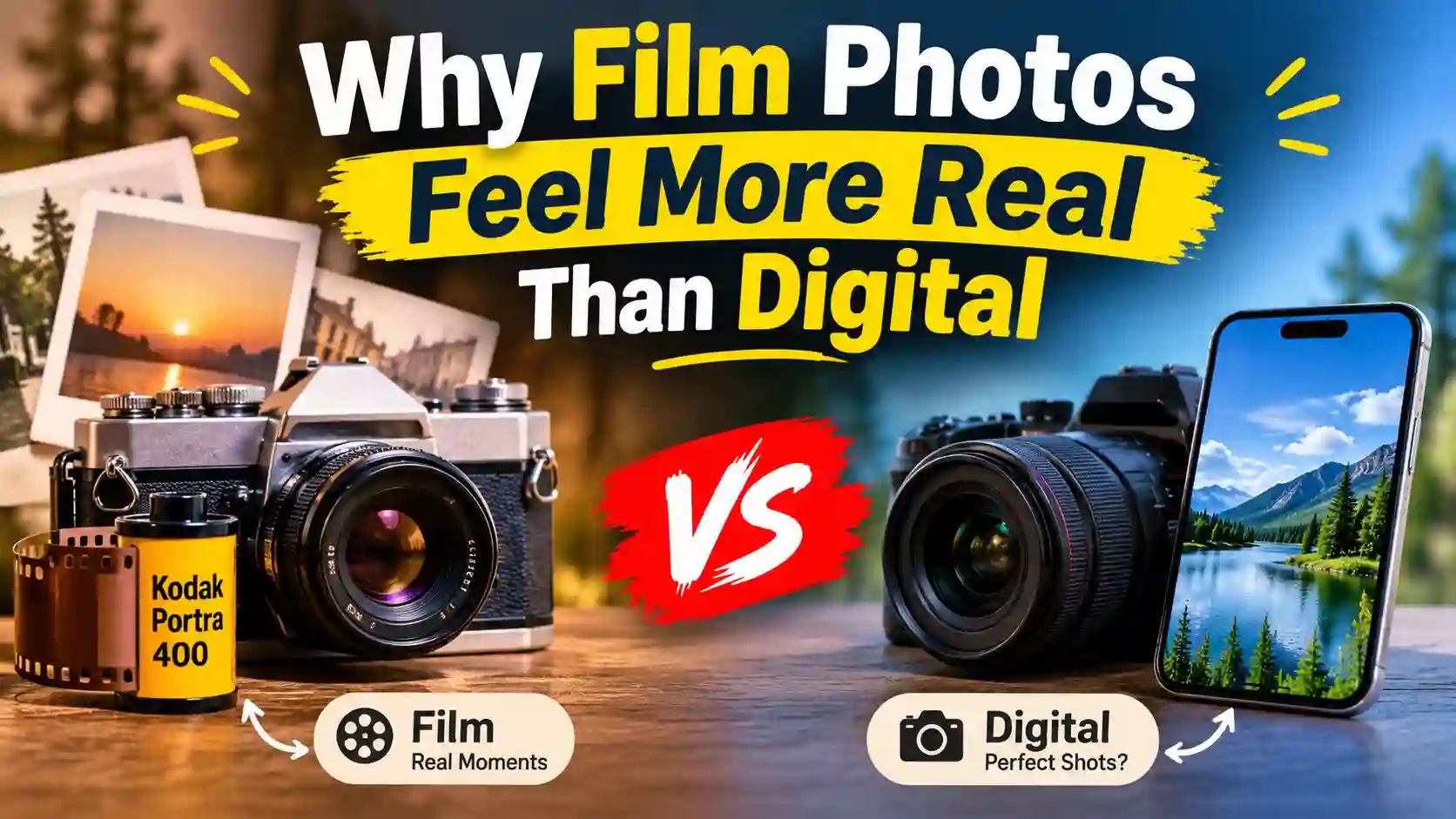
Why Film Photos Feel More Real Than Digital
Grain, highlight rolloff, memory research and AI doubt all explain why film photos feel more real than digital. Here is what is really going on.
Film photos feel more real than digital because a film frame is a physical trace of light, its flaws are random like the world itself, and every shot cost you something to take. A modern phone can out-resolve most 35mm film, yet a slightly soft frame of Kodak Portra 400 often feels closer to the moment than a crisp 48-megapixel file. That gap is not in your head, and nostalgia is only one small piece of it. After years of shooting film and digital side by side, I find the honest answer mixes chemistry, the way our eyes read texture, memory research and a growing distrust of AI images. Below you will find the science behind the look, the studies on how photos shape memory, and the blind tests that complicate the story. By the end, you will know exactly why film photos feel more real than digital, and how to bring that feeling into your own pictures.
The Question Photographers Have Been Getting Wrong
"Grain, Warmth, That Look" Describes Film but Doesn't Explain It
Ask most photographers about film and you will hear the same three answers, which are grain, warmth and that look. Those words are accurate, but they only describe what a film photo looks like on the surface. Most film vs digital photography debates stop right there, which is why they keep going in circles. They never explain why a faded print of your grandparents can stop you cold while a perfect phone photo gets a quick scroll. If film photos feel more real than digital, the reason has to sit deeper than texture and colour. Grain can be added to any digital file in seconds, and warmth is one slider away in Lightroom.
Is It Just Nostalgia?
Nostalgia is the easy answer, but it falls apart when you look at who is buying film right now. Gen Z grew up with smartphones, yet young shooters are a big force behind today's film boom. The writer John Koenig coined a word for this feeling in The Dictionary of Obscure Sorrows, and that word is anemoia. It means nostalgia for a time you never lived through, which explains part of the pull. Still, longing for the past cannot explain why film photos feel more real than digital even when the roll was shot last week. Nostalgia shapes how we read old images, but the medium itself is doing real work too.
The Difference Between a Record and a Trace
How Light Physically Changes Film
A film frame is coated with an emulsion, which is a thin layer of gelatin holding millions of tiny silver halide crystals. When light from the scene hits those crystals, it changes them chemically and leaves an invisible pattern called a latent image. Development then turns that hidden pattern into a visible negative you can hold up to a window. Nothing in that chain guesses or fills in missing details, because the light itself did the work. That direct physical link is one big reason film photos feel more real than digital, since the negative is a leftover piece of the actual moment.
Barthes and "That Has Been"
The French writer Roland Barthes tried to name this feeling in Camera Lucida, his 1980 book about photography and grief. He argued that the core message of any photograph is "that has been," meaning this person or place truly stood in front of a lens. Thinkers call this link indexicality, which is a fancy word for a sign that was physically caused by the thing it shows. The theorist Kaja Silverman compares a photo to a footprint, because both prove that something real was there. A strip of negatives makes that proof easy to feel, since you can literally hold the trace in your hand.
How a Phone Builds a Photo From Code
A modern phone works very differently, even though the result looks like a normal photo. When you tap the shutter, computational photography merges several frames, blends exposures with Smart HDR and runs AI enhancement on faces and skies. The sensor data becomes code, and software then rebuilds that code into the image the phone thinks you wanted. So the camera keeps a record of the light, but it also adds its own guesses on top of that record. Viewers often sense that extra layer of interpretation without spotting it, so by contrast film photos feel more real than digital.
The Science Behind the Film Look
Film Grain vs Digital Noise
The debate about film grain vs digital noise sounds technical, but it explains a lot about how our eyes judge an image. Film grain comes from silver crystals scattered at random through the emulsion, so no two frames ever share the same pattern. Digital noise comes from tiny electrical errors on a sensor, and those errors sit on a fixed grid of pixels. Our brains are very good at spotting patterns, so even faint banding or blotches read as a fault in the picture. Grain is mostly changes in brightness, while digital noise often shows coloured speckles, especially blue ones in dark shadows. Newer sensors produce far more random noise than older ones, so the gap is shrinking every year. Even so, random texture is a big part of why film photos feel more real than digital to most viewers.
Highlight Rolloff: Why Film Fades Instead of Clipping
Highlight rolloff describes how an image handles the brightest parts of a scene, like a window, a sunset or a white dress. Each pixel on a digital sensor fills with light in a straight line until it reaches its limit, and then it clips to flat white. Colour negative film reacts along a curve instead, so bright areas build density slowly and keep detail long after digital gives up. Film also has more room in the highlights than the shadows, which is the opposite of how digital behaves. When a bright sky melts gently into white rather than ending at a hard edge, film photos feel more real than digital without you knowing why.
Halation and the Glow Around Light
Halation is the soft glow you see around streetlights and neon signs on some film shots. It happens when light passes through the emulsion, bounces off the film base and spreads back out. Most stocks include an anti-halation layer to limit it, but CineStill 800T removes that layer on purpose and glows red around every bright light. Digital sensors never create halation, so that real glow helps film photos feel more real than digital in night scenes.
Colour From Dye Layers, Not Pixels
Colour film stacks three sensitive layers, one each for red, green and blue light. During C-41 development, those layers form cyan, magenta and yellow dyes, so the colour you see is built from dye clouds rather than a grid of pixels. A Bayer sensor, by contrast, records one colour per pixel and lets software guess the rest. The orange mask on colour negatives was designed to correct the dyes and help printers reach natural skin tones. On skin, that careful colour design is where film photos feel more real than digital most clearly, which is why portrait shooters still trust Portra.
Why Imperfection Signals Truth
Random Flaws Feel Natural, Patterned Flaws Feel Fake
Real life is messy in random ways, with dust in the air, uneven light and skin that is never perfectly smooth. Film records that mess with its own random flaws, so the picture and the world share the same kind of imperfection. Digital problems tend to be regular, like banding, oversharpened edges or smoothing that treats every face the same way. Our eyes accept random flaws as part of the scene but flag patterned ones as something done to the scene. That difference explains how film photos feel more real than digital even when they are technically weaker, because their errors look natural.
When Phone Photos Look "Over-Real"
Many phone owners now complain that their pictures look fake, and the complaints are surprisingly specific. People mention neon skies, plastic-looking skin and grass so evenly green it looks painted. Sebastiaan de With, one of the makers of the Halide camera app, described some iPhone shots as "over-real," because they show more shadow and highlight detail than your eye ever saw. That is the heart of the problem, since an image that shows more than reality starts to feel less like reality. Overprocessed phone photos are not bad photos, but they look constructed rather than captured. Here, film photos feel more real than digital simply because film cannot invent detail that never reached the emulsion.
The Happy Accident (Barthes' Punctum)
Barthes also gave us the word punctum, which means the small unplanned detail that pierces you when you look at a photo. It might be a stranger's hand at the edge of the frame or a light leak across a birthday cake. Film produces these accidents often because you cannot check a screen and reshoot, so the surprises stay in the final picture. Because nobody arranged those moments, they make film photos feel more real than digital in a way a planned shot rarely can.
What "The Look" Is Actually Communicating
Time and Place, Not Just Film Stock
Some of what we call the film look has nothing to do with film at all. Old photographs feel old because of what sits inside them, such as the cars, clothes, hairstyles and wallpaper of their era. The photographer Max Kent makes this point in an Fstoppers video, adding that today's photos will look nostalgic to someone in twenty years. That is why digital presets rarely match a real 1970s snapshot, since the setting itself has changed. So part of the reason film photos feel more real than digital is that we compare new digital images with old film memories.
Proof of Reality in the Age of AI
The rise of AI images has turned this old debate into a practical one. Adorama argued in July 2026 that proof of reality is replacing perfect photos as the thing audiences value. A flawless sunset or a perfectly lit portrait now raises suspicion instead of admiration, because people know software can fake both. Brands feel this too, since Adobe reported in 2026 that one third of customers would stop engaging with a brand if its content turned out to be AI-generated. Camera makers are responding with content credentials, and Canon added C2PA support to the EOS R1 and R5 Mark II in 2025. Nikon also offers an Authenticity Service so newsrooms can check where an image came from. Against that background, film photos feel more real than digital because a negative suggests a real camera stood in front of a real scene. As you will see later, a negative is not perfect proof, but it still carries strong emotional weight.
The Memory Angle: Why We Remember Film Photos Differently
The Photo-Taking Impairment Effect
Psychologist Linda Henkel ran a well-known museum study, published in Psychological Science in December 2013. Visitors who photographed objects remembered fewer details about them than visitors who just looked. Henkel called this the photo-taking impairment effect, and she explained that people let the camera do the remembering for them. Julia Soares and Benjamin Storm tested the idea again in 2022 and found that the effect held up well. In their study, taking five photos of an object actually hurt memory more than taking just one. That finding matters for phone users, who often fire off a burst of shots without a second thought. It also hints at why film photos feel more real than digital in our minds, since fewer and slower shots may leave more room for the moment itself.
Why Deliberate Shots May Protect Memory
Henkel found one twist that film shooters will recognise straight away. When visitors zoomed in on a specific detail before taking the picture, the memory loss disappeared. Focusing your attention seems to protect the memory, even while the camera is recording. Shooting a roll of 36 frames forces that kind of attention, because every frame costs money and you cannot delete a bad one. Nobody has tested film cameras directly, so treat this as a reasonable idea rather than proven science. It still fits the common report that film photos feel more real than digital to the person who pressed the shutter.
Prints You Can Hold
A digital photo usually lives in a camera roll with thousands of others, and most never get printed. A film photo almost always becomes a physical object, either a print, a negative strip or both. You can pass a print around, pin it to a wall or tuck it into a photo journal. Each time you pick it up, you revisit the moment without a notification pulling you away. Alixandra Barasch found that taking photos mainly to share them raises worry about how we look and can lower our enjoyment. A print you keep for yourself removes that pressure and lets the memory belong to you.
Can People Actually Tell Film From Digital?
What Blind Tests Show
This is the part most film fans skip, so it deserves an honest look. RedShark News reviewed several blind tests and found that self-described experts often voted real film shots as digital. In an Emulsive survey of 104 people, most could not tell real Kodak Tri-X from a digital file run through DxO FilmPack. Side-by-side tests are a little kinder to film, and in one test by The Slanted Lens the writer scored 22 out of 24. The lesson is that good film emulation can fool most viewers when they see a single image on a screen. So if you ask whether film photos feel more real than digital purely because of how they look, the evidence says the gap is smaller than we think. The feeling comes as much from knowing how a photo was made.
Why a Negative Isn't Proof Anymore
Many people now treat a negative as a certificate that a photo is real. One photographer writing for DIYPhotography tested that idea by showing AI-generated images on a 4K television and photographing the screen on film. The result was a genuine negative of a scene that never existed, which shows how easily that proof can be faked. Members of photography forums such as FredMiranda have raised the same point in recent threads about AI. Film photos feel more real than digital, but feeling real and being proven real are two different things.
The Practical Implications: What This Means for How You Photograph
Shoot Fewer, More Deliberate Frames
You can borrow the best part of film without buying a single roll. Before you press the shutter on any camera, decide what the picture is about, using simple photo composition rules, and wait for the right moment. Setting a limit, like twelve frames for a whole afternoon, shows you quickly how deliberate shooting makes film photos feel more real than digital.
Expose for Your Medium (Highlights vs Shadows)
Film and digital need opposite exposure habits because they protect different ends of the scene. With colour negative film, it is safer to overexpose a little, since the highlights have plenty of room. With digital, protect the highlights instead, because once a sky clips there is nothing left to recover. Getting this one habit right covers half of the film look on either camera.
How to Get a More Natural Look From Your Phone
If your phone photos look overprocessed, switch to a pro or RAW mode that skips most of the automatic editing. Apps such as Halide also capture images with more natural texture and gentler sharpening. On an iPhone, try turning off View Full HDR in the Photos settings to check whether the screen was causing the harsh look. These steps will not turn phone files into film, but they remove the heavy processing that makes film photos feel more real than digital by comparison.
Print Your Favourite Photos
Pick ten favourite photos each month and print them at home, whether they came from film or a phone. A small stack of prints gets looked at far more often than a folder in the cloud, and handling them now and then keeps those memories active.
Is Shooting Film Worth the Cost?
Film is not cheap anymore, and Kodak Portra 400 costs about $15 to $20 a roll before development and scanning. If you want sharp files fast, digital is the better tool for the job. If you want slower habits, a physical archive and surprises you cannot plan, film is well worth trying.
Why Polaroid Specifically Endures
One Print, No Negative, No Copy
Polaroid photography takes the trace idea further than any other kind of film. Integral instant film produces one single print with no negative, so the object in your hand is the only copy that will ever exist. Edwin Land, who founded Polaroid, made that instant, one-of-a-kind print the company's signature product. If you lose it, the moment is gone, and that risk makes people handle each print with real care. This is why a faded Polaroid of a family member can feel more precious than a whole album on your phone. It is also why so many people say instant film photos feel more real than digital ones.
Instant but Irreversible
The SX-70, launched in 1972, made instant photography fast without making it forgiving. You see the result in minutes, but you cannot undo a bad exposure, crop out a stranger or apply a filter afterwards. That mix of speed and permanence is rare, because most fast tools today also let you edit everything. A Polaroid gives you quick results while keeping the honesty of an untouched print, which helps instant film photos feel more real than digital snaps.
The Shared Moment of Watching It Develop
A Polaroid print takes about 10 to 15 minutes to develop fully, and people tend to gather around and watch it appear. That shared wait turns the photo into a small event, which ties the print to everyone who was there. Nobody gathers around a phone screen to watch a file finish saving. It is one more reason film photos feel more real than digital at parties, weddings and family dinners.
Why Film Is Making a Comeback in 2026
The film photography revival is no longer a small hobby trend, and the numbers back that up. Film sales peaked in 2003 at over a billion rolls and hit bottom around 2015, after many stocks were discontinued. Since about 2020, interest in film has more than tripled, according to Matt Growcoot of PetaPixel. Kodak's film sales are now estimated at around $100 million a year, based on an analysis by Chemical and Engineering News. In March 2026, Eastman Kodak took back direct distribution from Kodak Alaris, and Portra now ships under the new Ektacolor name. The same change renamed Kodak TMAX black and white film as Ektapan. Fortune reported in July 2026 that 35% of the world's 42 million film camera users are under 30. Los Angeles also hosted the first AnalogCon festival for analog photography in April 2026. New film labs have opened as demand returns, which makes developing easier than it was a few years ago. All of this growth rests on one simple idea, that film photos feel more real than digital to a generation raised on screens.
Looking at the Right Thing
After all the chemistry and research, the answer comes down to what you are really looking at. You are not just seeing grain or colour, but a trace of light, a choice the photographer made and a memory that had room to form. Film photos feel more real than digital because they carry all three in a way that is hard to fake and easy to feel. Digital can match the look, and in blind tests it often does, so resolution and texture were never the full story. The good news is that you can bring the same honesty to any camera you own. Shoot with intention, protect your highlights, turn down heavy processing and print the frames that matter. Do that, and your photos will feel real because they are real, whatever camera you used.
Frequently Asked Questions
Why does film look better than digital when digital is technically sharper?
Sharpness is only one part of what makes a photo pleasing. Film has softer highlight rolloff, random grain and colour built from dye layers, so it renders scenes more gently. Knowing a shot was taken with care also shapes the viewer's reaction, which is a large part of why film looks better to many people.
Is film grain just the same thing as digital noise?
No, they come from different sources and look different up close. Grain is random silver or dye texture inside the film, while noise comes from electrical errors on a sensor grid. Grain is mostly brightness variation, but digital noise often shows coloured specks, which our eyes find more distracting.
Why do my iPhone photos look fake and plasticky?
Your iPhone blends several frames, applies Smart HDR and sharpens edges to make every shot bright and clean. In tricky light, that processing can flatten depth and smooth skin too much. Shooting in a RAW mode or using an app like Halide usually gives a more natural, less processed result.
Can I make digital photos look exactly like film?
You can get very close, and blind tests show most viewers cannot spot the difference in single images. Tools like DxO FilmPack copy grain and colour well. Halation and highlight rolloff are harder to fake, and no preset can recreate the physical negative or the slower way you shot it.
Why do grainy photos sometimes feel more real than clean ones?
Random grain gives the eye fine texture to explore, much like looking at a real scene. Very clean, heavily processed images can look smooth in a way the world never does. That is why so many people say film photos feel more real than digital, even when the digital file holds more detail.
Does film really have more dynamic range than digital?
Not overall, because modern sensors roughly match colour negative film and beat slide film. The real difference is how each medium spends that range. Film keeps more detail in bright areas and fades gently into white, while digital holds shadows better but clips highlights sharply.
Can a film negative prove a photo is not AI?
A negative alone can no longer prove that a photo is real. One photographer has already shot AI images off a television screen onto film, creating genuine negatives of fake scenes. Newsrooms now rely on content credentials such as C2PA to check where an image came from.
Is film photography worth it in 2026?
It depends on what you want from photography. If you value slower shooting, physical prints and the reasons film photos feel more real than digital, then a roll or two each month is worth the cost. If speed and low cost matter most, digital remains the smarter choice.
Keep reading
- Choosing the right photo paper helps your film and phone prints last.
- The Y2K Photo Booth Aesthetic guide shows how to get the vintage film strip look free.
- The Cultural History of the Photo Booth traces 100 years of strips and selfies.
Ready to try this in your browser?
Launch our free 3D studio, test out vintage filters, and save your photo strip instantly.