The Cultural History of the Photo Booth: 100 Years of Strips, Selfies and Friendship
Photo booth history from the 1920s Broadway Photomaton to purikura and Korean 4-cut strips, and how a 25-cent machine shaped 100 years of selfies.
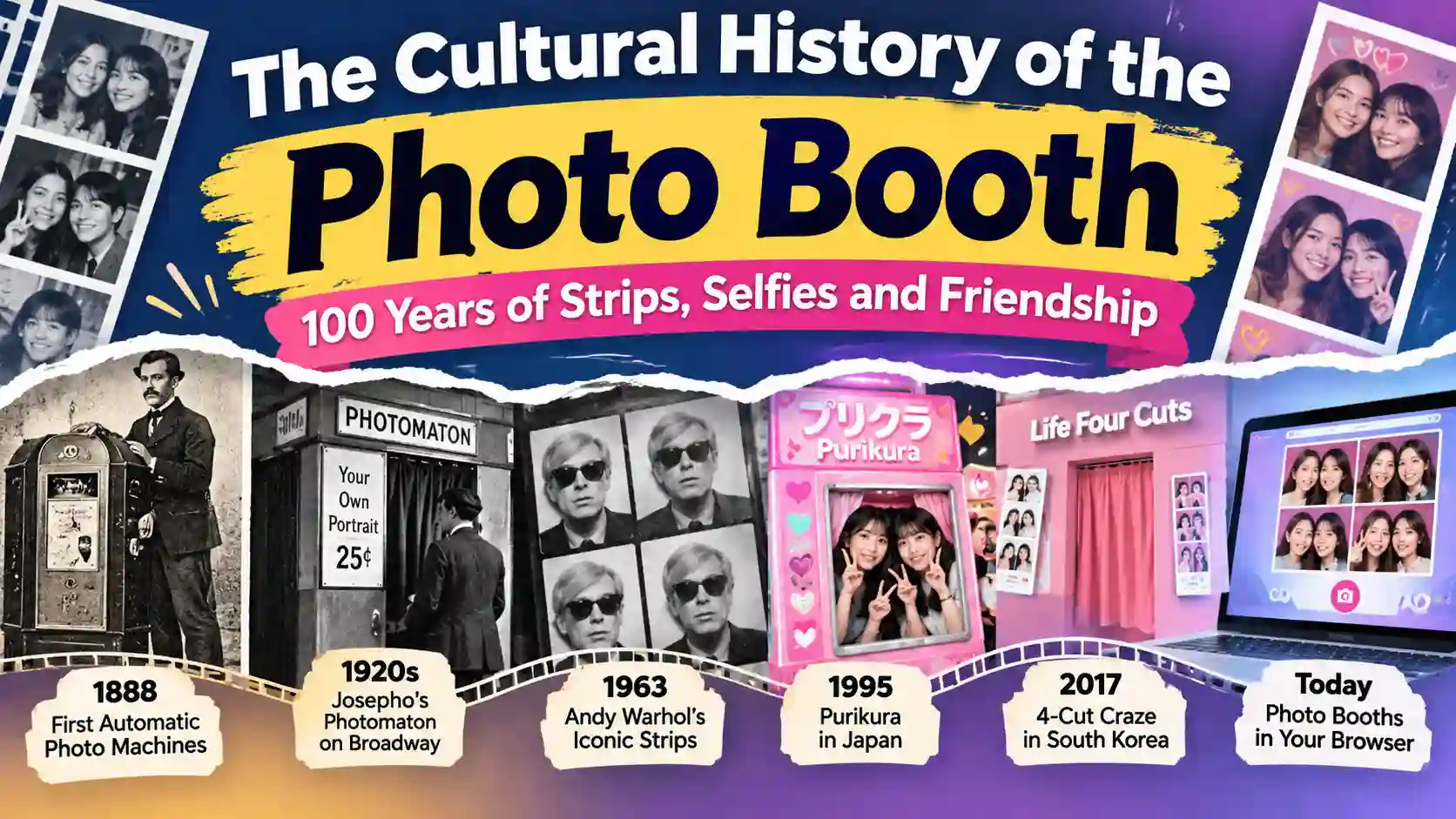
In the mid-1920s, people in New York paid 25 cents to sit behind a curtain on Broadway and wait for eight tiny portraits. A century later, a university student in Seoul and two childhood friends squeezed into a Korean 4-cut photo booth for the same small thrill. Photo booth history fills the hundred years between those two moments, and it shows how much people love to see themselves. This is the cultural history of the photo booth, from Anatol Josepho's Photomaton to Japanese purikura and Andy Warhol's Times Square strips. It ends with the browser booths you can open on your phone today. Along the way, you will spot one idea that keeps coming back. People never went to booths for perfect pictures, since what they wanted was a private, playful place to be seen on their own terms. That simple wish is the reason photo booth history is still being written.
Photo Booth History at a Glance
Photo booth history starts with coin-operated photo machines in the late 1880s and takes off with Anatol Josepho's Photomaton in the mid-1920s. From Broadway, the booth spread to Paris artists, train stations, Japanese arcades and Korean shopping streets. Today it also lives inside your web browser.
These key dates show how each era handed the photo strip to the next one.
| Year | What happened |
|---|---|
| 1888 | William Pope and Edward Poole of Baltimore file the first patent for an automatic photo machine |
| Mid-1920s | Anatol Josepho opens the Photomaton on Broadway (sources say 1925 or 1926) |
| 1929 | The Photomaton reaches Paris, where Surrealist artists pose inside it |
| 1952 | Photo-Me brings booths to the UK, and the company still runs them as ME Group |
| 1963 | Andy Warhol turns Ethel Scull's booth photos into a famous painting |
| 1995 | Atlus and Sega launch Print Club, the first purikura machine, in Japan |
| 2017 | Life Four Cuts opens in South Korea and starts the 4-cut strip craze |
| 2025 | The photo booth turns 100, and a Melbourne exhibition marks the date |
Before the Booth: The First Automatic Photo Machines (1888-1896)
The first automatic photo machines appeared between 1888 and 1896, almost 40 years before the Photomaton. None of them could run for long without help, and they printed slow, fragile ferrotypes on thin metal plates. That kept them a fun experiment rather than a real business, so they form the quiet first chapter of photo booth history.
The story starts in 1888, when William Pope and Edward Poole of Baltimore filed a patent for an automatic photo machine. A year later, the French inventor T. E. Enjalbert showed a working model at the 1889 World's Fair in Paris. In the same year, Mathew Steffens of Chicago filed his own patent. In 1890, Conrad Bernitt of Hamburg patented the "Bosco," which became the first of these machines to make real money. Then in 1896, Carl Sasse of Germany built a machine that used negatives and positives, the method that film would follow for a century.
A Machine for Being Seen: The Photomaton on Broadway
The modern photo booth was born on Broadway in New York City in the mid-1920s. The Photomaton let people take their own portraits with no photographer in the room. A coin, a curtain and an automatic camera did all the work. Every booth since then has copied that simple idea. To see why it caught on so fast, meet the man who built it and the crowds who queued outside. Both of them shaped photo booth history from day one.
Who Invented the Photo Booth?
Anatol Josepho invented the photo booth. He was a photographer from Tomsk, Russia, who moved to the United States in 1923 and built the Photomaton in New York. He filed his patent on March 27, 1925, and it was granted on June 7, 1927.
Josepho was born in 1894 as the son of a jeweler, and as a boy he fell in love with his Kodak Brownie camera. By the age of 19 he ran his own studio in Budapest, and he later worked as a photographer in Shanghai. All those years behind the camera gave him one clear goal. He wanted a machine that could take a good portrait with nobody there to run it. That goal made him the biggest name in photo booth history.
25 Cents, 8 Photos and a Queue Around the Block
The first Photomaton charged 25 cents for a strip of eight photos, and you waited about eight to ten minutes while the machine developed them. Time magazine reported that around 280,000 people used it in its first six months. That figure is still one of the most famous numbers in photo booth history.
The crowds grew so big that white-gloved attendants stood beside the booth to keep the line moving. Future US President Franklin D. Roosevelt even sat on the board of the Photomaton Company, which placed booths across the country. Josepho later sold the rights for $1 million to a group led by Henry Morgenthau Sr. Sources date the sale to 1927 or 1928, and Josepho put half of the money into a charity trust.
Why People Chose a Machine Over a Portrait Studio
People chose the Photomaton over a portrait studio because the booth gave them a picture that felt like their own. A studio photographer posed you for a serious, official portrait. The booth let you decide how to sit, smile or pull a face.
Studios were easy to find in 1920s New York, so the crowds on Broadway were not there only to save money. They came for the freedom to make an image of themselves without anyone telling them to hold still. That freedom is what the booth has offered ever since, and you will see it again in every chapter of photo booth history.
The Curtain: A Private Room in a Public Place
The curtain matters because it turns a busy street, station or mall into a tiny private room. Once it closes, nobody outside can watch you. People relax, make silly faces, kiss or try on a new look that they would never show a crowd.
Across photo booth history, booths have stood in places full of strangers, like train stations, shopping centers and arcades. You spend most of your day in spaces like these acting a little careful, because you know people can see you. The thin curtain gives you a break from that feeling for about a minute. That short break changes how you act in front of the camera.
That is why so many old strips in photo booth history look so loose and happy. The people in them were not posing for a photographer or a passing crowd, so they could laugh with their whole face. The classic photo strip helps too. Its four small frames sit on paper about 40 mm wide and 205 mm long, so it fits into a wallet or a diary. It stays a small private keepsake, and you choose who gets to see it. Our guide to starting a photo journal shows easy ways to keep your own strips safe for years.
Why People Always Squeeze Into the Booth Together
People usually enter photo booths in pairs or groups because sharing a small, silly moment makes it more fun and easier to remember. Squeezing three friends onto one seat turns a quick photo into a little adventure. The strip then becomes proof that you were there together.
Solo visits do happen, but they often feel a bit awkward. Most of the best strips in photo booth history show friends, couples or families pressed cheek to cheek. Doing something a little ridiculous with another person builds a bond, and the camera catches that bond in the middle of a laugh. Japanese purikura makers understood this so well that their booths hold four to eight people, according to the BBC.
The same habit is alive in Korea today. The Korea Herald spoke to Ha Yoo-ra, a 20-year-old student in Seoul. She had been friends with two classmates since elementary school, but they had never taken a nice photo together. The three of them finally dressed up and visited a 4-cut booth to mark their years of friendship. The same spirit sits behind most wedding photo booth ideas, which start with getting guests into one frame.
When Artists Stepped Behind the Curtain
Artists saw the photo booth as a creative tool almost as soon as it arrived. Surrealists in 1920s Paris and Andy Warhol in 1960s New York used its automatic strips for serious art. Musicians and filmmakers followed, giving photo booth history its creative side.
The Surrealists and the Paris Photomaton (1929)
When the Photomaton reached Paris in 1929, the Surrealist artists quickly adopted it. André Breton, Salvador Dalí, René Magritte and the filmmaker Luis Buñuel all posed in booths. A camera with no person behind it matched their love of chance and unplanned images.
The Surrealists wanted art that came from the hidden mind rather than from careful planning. A booth fit that goal well, since you could not see the camera or control the timing. You never knew which face you would get, so the strip became a small surprise. It showed a side of a person that a posed studio photo would hide. That is why their Paris strips are some of the most talked-about pictures in photo booth history.
Andy Warhol's Times Square Strips
In 1963, Andy Warhol took the art collector Ethel Scull to a photo booth in Times Square. She sat for about 300 black-and-white pictures. Warhol turned them into Ethel Scull 36 Times, his first commissioned portrait and a big step in his career.
Warhol told Ethel jokes during the session so her faces would look relaxed instead of stiff. The finished work shows her in 36 panels, laughing, turning and covering her face. The Metropolitan Museum of Art and the Whitney Museum of American Art now own it together. A hand-colored strip from the same session belongs to the J. Paul Getty Museum. That makes the Scull session one of the best-known moments in photo booth history, since quick booth pictures now sit in major museums.
Photo Strips in Music and Film
Photo strips also became a symbol of real, unposed moments in music and movies. John Lennon and Yoko Ono put a strip in the packaging of their 1969 Wedding Album. The 2001 French film Amélie then built its love story around a photo booth.
In Amélie, the shy heroine played by Audrey Tautou falls for Nino, played by Mathieu Kassovitz. Nino collects torn and thrown-away booth photos in an album. Those forgotten strips of strangers become the thread that pulls the two of them together. That plot gives the film a sweet place in photo booth history.
Why the Photo Booth Never Died
The photo booth never died because new cameras could copy its pictures but could not copy the experience. Polaroid instant film arrived in 1948, and then came film cameras, digital cameras and smartphones. People still line up for the curtain, the countdown and the printed strip.
Each new camera should have made booths useless, but the history of the photo booth shows the opposite happening again and again. In 1952, Photo-Me brought a compact developing process from California to the UK. The company still runs booths today as ME Group. Melbourne holds a special place in photo booth history, because a booth at Flinders Street Station has worked there since 1961. It prints three black-and-white frames, a size left over from the days when taxi drivers needed ID photos.
Its owner, Alan Adler, kept his booths running for more than 50 years. When he was told in 2018 to remove the Flinders Street booth, public anger won it a new spot inside the station. Adler died in 2024 at the age of 92. In 2025, the RMIT exhibition Auto-Photo: A Life in Portraits marked 100 years of photo booth history. Rental booths kept the story growing too, and by 2016 rental searches beat DJ searches in 15 big North American cities.
Purikura: How Japan Turned the Booth Into a Friendship Ritual
Purikura is the Japanese photo sticker booth, and it turned the booth into a friendship ritual for teenage girls in the 1990s. The first machine, Print Club, launched in February 1995 from the game company Atlus and its partner Sega. It let friends decorate their pictures before printing them as stickers.
The idea came from Sasaki Miho, an Atlus employee who noticed how much schoolgirls loved stickers. Her bosses turned the idea down at first, and sales were slow after the launch. Everything changed when the boy band SMAP showed Print Club on their TV variety show in early 1996. It became Japan's highest-grossing arcade game of 1996, and about 45,000 booths were running by the summer of 1997.
Purikura makers kept adding fun tools, and from 1998 users could draw graffiti and add hearts and stars to their photos. About ten years after the launch, a survey found that 43% of Japanese girls aged 10 to 15 called purikura their top activity. Anthropologist Laura Miller studied these booths as a way for young women to express themselves. That makes purikura Japan's biggest gift to photo booth history and to photo booth culture as a whole.
Doodles, beauty filters, cat whiskers and bunny ears may sound familiar, because Snapchat and Instagram later picked up the same ideas. Atlus left the business in 2009, and Furyu became the market leader. The purikura look also lives on in the Y2K photo booth aesthetic.
Korean 4-Cut Booths: When the Strip Became a Weekly Habit
Korean 4-cut booths are self-service photo studios that print four pictures in a slim vertical strip. They made the photo booth an everyday habit in South Korea. Life Four Cuts started the trend in 2017, and rivals like Photoism, Photomatic and Haru Film now fill shopping streets across the country.
Walk through Hongdae or Seongsu-dong in Seoul and you will find these unmanned studios on almost every block. Most stay open 24 hours and give instructions in English, Japanese and Chinese. Two prints cost 4,000 won, or about $2.91, and the soft lighting and gentle skin smoothing help people look their best. That low price and flattering look explain why students drop into a Korean 4-cut photo booth as casually as a coffee shop.
The booths also use special frames to bring people back. Photoism has offered limited frames with the singer IU and with Yoshi from the K-pop group Treasure. Baseball fans can even pose next to players from all ten KBO teams. Life Four Cuts told the Korea Herald it has had 120 million visits since 2017 and runs about 410 stores in Korea. With branches in Singapore and London, it is the newest big chapter in photo booth history. For many young Koreans, a booth visit became something they repeat often, the way they meet friends for lunch. Our guide to photo booth layouts and frames explains how the 4-cut strip works.
The Digital Photo Strip: The Booth's Newest Home
The digital photo strip is the newest home of the photo booth. Browser and webcam booths keep the countdown, the poses and the printed-strip look. They drop the coin slot and the queue, so you can make a photo booth selfie strip on a phone, laptop or tablet at home.
Online booths grew from the same DIY spirit that started the rental boom, when people first linked digital cameras, printers and laptops together. Today the camera is already in your pocket, so the only thing left to copy is the feeling of the booth. A good online booth gives you a short countdown, a few poses and a strip that looks like a real print. Its film-style filters copy the look of a vintage photo booth, which links this new chapter to the rest of photo booth history.
Privacy still matters, just as it did behind the old curtain. At TryPhotoBooth, the camera runs inside your browser, and your photos are not stored unless you share them in the Weekly Spotlight gallery. There is no signup and no watermark, so the booth feels as simple as the Photomaton once did. You can read more about how an online photo booth works if you want the details.
Recreate Every Era of the Photo Booth for Free
You can recreate every era of photo booth history for free with TryPhotoBooth by matching each period to a layout and a filter. Pick the layout, add the filter and copy the poses of the time, and your strip will look like it came from that decade.
| Era | Layout and filter | How to pose |
|---|---|---|
| 1920s Photomaton | Classic 3-pose strip (Layout A), black-and-white filter | Serious face, smile, side look |
| Melbourne ID era | Classic 3-shot vertical strip | Calm, steady look |
| 1960s Warhol | 4-cut grid, high-contrast black and white | Laugh, turn, cover your face |
| Vintage keepsake | Vintage Polaroid with date stamp | Add a short caption |
| 1990s purikura | Hearts strip, bunny ear or crown overlays, stickers | Squeeze in with friends |
| Korean 4-cut | Korean 4-cut strip (Layout B), soft film filter | Four steps, one frame color |
Every strip exports at 300 DPI, so you can print the whole set and line the eras up on a wall.
What 100 Years of Photo Booths Say About Us
A hundred years of photo booths show that people want more than a picture. From Broadway to Shibuya to Seongsu-dong, we keep coming back to the same small ritual. There is a short wait, a few quick poses and a strip we can hold, share or hide away.
The machines changed a lot along the way, moving from ferrotypes and chemical tanks to touchscreens and webcams. Even so, the reason people step inside has barely moved. They want a private, playful space where they can be themselves with the people they love. That need ties all of photo booth history together. The next chapter is easy to start, because you can open a free online photo booth today. Call a friend over, pick a layout and make your own strip in about a minute.
Frequently Asked Questions
Who invented the photo booth?
Anatol Josepho, a Russian-born photographer, invented the modern photo booth. He filed his patent in 1925 and opened the Photomaton on Broadway in the mid-1920s. Earlier inventors like William Pope, Edward Poole and Conrad Bernitt built automatic photo machines in the 1880s and 1890s. Those early machines never worked well on their own, so photo booth history usually starts its real story with Josepho.
How much did the first photo booth cost?
The first photo booth cost 25 cents for a strip of eight photos. That price bought a short session behind the curtain and about eight to ten minutes of waiting while the machine developed the pictures. Around 280,000 people paid it in the first six months, according to Time magazine, which gave photo booth history a strong start.
Why are photo booths so popular?
Photo booths are popular because they mix privacy, play and a printed keepsake. The curtain lets you relax, the countdown pushes you into fun poses and the strip gives you something to hold. Korean booths add low prices and idol frames, while Japanese purikura adds stickers and doodles, so photo booth history keeps finding new fans.
How does a photo booth capture your image?
A photo booth captures your image with an automatic camera, fixed lighting and a timer that signals each pose. Old film booths developed the strip with chemicals inside the machine, which took several minutes. Modern digital booths use a digital camera and a computer, then print or send your photos in about 30 seconds.
What is purikura?
Purikura is a Japanese photo sticker booth. The name comes from Print Club, the first machine, which Atlus and Sega launched in 1995. You pose with friends, decorate the photos on a touchscreen with stamps, text and beauty effects, and then print them as stickers to share.
Are old film photo booths still around?
Yes, a few old film booths still work, though they are rare. The Flinders Street Station booth in Melbourne has run since 1961 and still prints black-and-white strips. Groups like Metro Auto Photo restore old machines, so fans of the analog photo booth can still find a living piece of photo booth history.
Keep Reading
If this story made you want to try a booth yourself, these guides are good next steps:
Ready to try this in your browser?
Launch our free 3D studio, test out vintage filters, and save your photo strip instantly.